
CLAT PG Syllabus 2026: The Common Law Admission Test for Postgraduate (CLAT PG) is the national-level entrance examination conducted by the Consortium of National Law Universities for admission to one-year LLM programmes at NLUs and other participating institutions. It also serves as a gateway for certain PSU legal recruitments. The exam emphasises comprehension of legal materials rather than pure rote memorisation.
The PG-CLAT focuses on testing a candidate’s ability to read, understand, analyse, and apply legal principles drawn from primary sources such as court judgments, statutes, and regulations. The syllabus is based on the mandatory subjects of the undergraduate law curriculum. There has been no major change in the core structure or subjects for the 2026 cycle, and the format remains consistent with recent years.
CLAT PG 2026 Exam Pattern
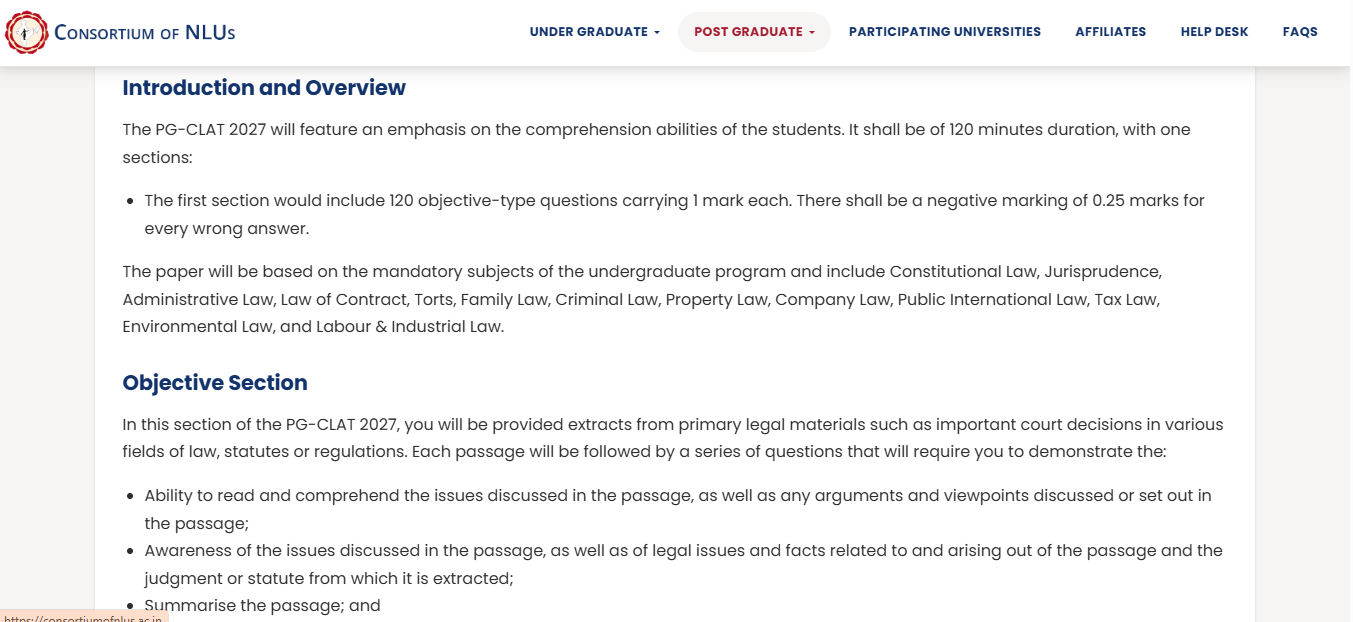
The examination is designed as a single-section, comprehension-based test of two hours. Candidates receive extracts from important court decisions, statutes, or regulations, followed by a series of objective questions. These questions assess reading comprehension of the issues and arguments in the passage, awareness of related legal issues and facts, the ability to summarise the material, and the capacity to apply knowledge of the relevant field of law.
The paper contains 120 multiple-choice questions, each carrying one mark. A negative marking of 0.25 marks applies for every incorrect answer. Unattempted questions carry no penalty. The test is conducted in offline (pen-and-paper) mode in English. Approximately 20–25 passages typically appear, with questions distributed across the listed law subjects.
| Particulars | Details |
|---|---|
| Mode of Examination | Offline (Pen and Paper) |
| Duration | 120 minutes (2 hours) |
| Total Questions | 120 Multiple Choice Questions |
| Total Marks | 120 |
| Marks per Question | 1 |
| Negative Marking | 0.25 mark deducted for each wrong answer |
| Medium | English |
| Question Style | Passage-based (from judgments, statutes, regulations) |
| Sections | Single section covering core law subjects |
Constitutional Law and Jurisprudence generally receive higher weightage, followed by Contract and Criminal Law, while other subjects appear with moderate or supporting representation. Exact distribution varies year to year depending on the passages selected.
Overview of CLAT PG Syllabus 2026
The syllabus draws from the mandatory subjects taught in the undergraduate LLB programme. Questions test both doctrinal knowledge and the ability to apply that knowledge to the given legal materials. Passages may come from recent or landmark judgments, statutory provisions, or regulations, requiring candidates to demonstrate understanding of the issues raised and related legal principles.
Preparation therefore involves refreshing knowledge of important judgments, constitutional and legislative provisions (especially those discussed in recent cases), and core concepts across the listed subjects. The emphasis is on analytical skills rather than mere recall of isolated facts.
CLAT PG Section-wise / Subject-wise Syllabus and Important Topics
The paper is not divided into rigid sections with fixed question counts. Instead, questions arise from the following subjects. Constitutional Law and Jurisprudence form the core, while the remaining subjects appear across the passages.
| Subject | Priority Level | Key Focus Areas |
|---|---|---|
| Constitutional Law | Highest | Fundamental Rights, Basic Structure, Federalism, Emergency, Judicial Review |
| Jurisprudence | Highest | Schools of law, Rights & Duties, Sources of law, Theories of punishment |
| Law of Contract | High | Essentials, Breach, Remedies, Specific contracts |
| Criminal Law | High | General principles, Offences against body/property, Exceptions |
| Administrative Law | Moderate | Natural Justice, Delegated legislation, Discretion |
| Law of Torts | Moderate | Liability principles, Negligence, Strict/Absolute liability |
| Family Law | Moderate | Marriage, Divorce, Maintenance, Succession |
| Property Law | Moderate | Transfer of Property concepts (Sale, Mortgage, Lease, Gift) |
| Company Law | Moderate | Incorporation, Directors, Corporate governance |
| Public International Law | Moderate | Sources, Treaties, State responsibility, Organisations |
| Tax Law | Supporting | Basic concepts of direct & indirect tax, GST overview |
| Environmental Law | Supporting | Key statutes (Air, Water, Environment Protection Acts) |
| Labour & Industrial Law | Supporting | Industrial relations, Key labour codes and principles |
Constitutional Law
Constitutional Law remains the highest-weightage area and frequently overlaps with other subjects. Candidates must thoroughly revise the salient features and historical background of the Indian Constitution, the Preamble, and citizenship provisions. Core topics include Fundamental Rights (Articles 12–35), Directive Principles of State Policy, Fundamental Duties, and the Doctrine of Basic Structure.
Important areas also cover judicial review, constitutional remedies under Articles 32 and 226, emergency provisions, federalism and Centre-State relations, amendment power under Article 368, anti-defection law, and significant Supreme Court judgments. Recent constitutional developments and landmark rulings often form the basis of passages.
Jurisprudence
Jurisprudence tests conceptual understanding of the nature and sources of law. Key areas include the major schools of jurisprudence — Natural Law, Analytical/Positivist, Historical, Sociological, and Realist schools — along with the contributions of thinkers such as Austin, Hart, Kelsen, and others.
Candidates should master concepts of rights, duties, legal personality, ownership, possession, liability, and Hohfeldian analysis of jural relations. Theories of punishment, the relationship between law and morals, and contemporary jurisprudential concepts also appear regularly. Passages often require application of these theoretical frameworks to judicial reasoning.
Administrative Law
This subject focuses on the principles governing administrative action. Central topics include the Rule of Law, principles of natural justice (audi alteram partem and nemo judex in causa sua), and control over administrative discretion.
Delegated legislation, its growth, and parliamentary, procedural, and judicial controls form another major area. Candidates should also study administrative adjudication, tribunals, liability of the administration, and the evolving relationship between constitutional law and administrative law. Emerging trends and recent judicial pronouncements on these themes are particularly useful.
Law of Contract
Contract law covers the formation, performance, and enforcement of agreements under the Indian Contract Act, 1872, and related statutes. Essential elements of a valid contract — offer, acceptance, consideration, capacity, and free consent — must be mastered thoroughly.
Other important topics include communication and revocation of offer/acceptance, elements that vitiate consent, contingent and wagering agreements, quasi-contracts, performance and discharge, breach of contract, and available remedies. Specific contracts such as indemnity, guarantee, bailment, pledge, and agency, along with doctrines like frustration and force majeure, frequently feature in questions.
Law of Torts
The law of torts examines civil wrongs and the principles of liability. Foundational concepts include the definition of tort, damnum sine injuria and injuria sine damno, and general defences such as consent (volenti non fit injuria), act of God, and private defence.
Key specific torts include negligence, nuisance, defamation, and trespass. Strict liability (Rylands v. Fletcher) and absolute liability (as developed in Indian jurisprudence), vicarious liability, and joint versus several liability are high-yield areas. Consumer protection principles also appear in relevant passages.
Criminal Law
Criminal law focuses on general principles and major offences. Candidates should revise the elements of crime (actus reus and mens rea), stages of crime, group liability, abetment, criminal conspiracy, and general exceptions.
Offences against the human body (culpable homicide, murder, hurt, grievous hurt, wrongful restraint/confinement, assault, kidnapping, abduction, and sexual offences) and offences against property receive significant attention. Procedural aspects and recent developments under the Bharatiya Nyaya Sanhita (while retaining familiarity with classic IPC jurisprudence) are relevant because passages may draw from either framework.
Family Law
Family law primarily covers personal laws relating to marriage, divorce, maintenance, adoption, guardianship, and succession under Hindu and Muslim law (and other personal laws as relevant). Judicial separation, grounds for divorce, and maintenance provisions form core topics.
Questions often test the interplay between personal laws and constitutional principles, as well as landmark judgments on these issues. A clear understanding of the statutory framework and judicial interpretations is essential.
Property Law
Property law centres on the Transfer of Property Act and related concepts. Important topics include the nature and types of property, sale, mortgage, lease, gift, exchange, and actionable claims.
Candidates should understand the rules governing transfer, rights and liabilities of parties, and doctrines associated with these transactions. Passages may involve application of these principles to factual or judicial scenarios.
Company Law
Company law covers the fundamental principles under the Companies Act, 2013. Key areas include incorporation and types of companies, doctrines such as lifting the corporate veil, the role and duties of directors, shareholders’ meetings, and corporate governance.
Topics such as listing/delisting of shares, mergers and acquisitions, and winding-up procedures may also appear. Focus remains on core statutory provisions and leading case law rather than minute procedural details.
Public International Law
Public International Law examines the legal framework governing relations between states and international entities. Core topics include the sources of international law (treaties, custom, general principles), the relationship between municipal and international law, and state recognition and succession.
Other important areas are state responsibility, international organisations, human rights in the international sphere, the law of the sea, air and space, and peaceful settlement of disputes. Passages often draw from treaties or significant international legal developments.
Tax Law, Environmental Law, and Labour & Industrial Law
These subjects generally appear with lower frequency but remain part of the official syllabus. Tax Law requires basic familiarity with residential status, heads of income, and the framework of direct and indirect taxes including GST.
Environmental Law covers major statutes such as the Water Act 1974, Air Act 1981, Environment (Protection) Act 1986, Forest and Wildlife laws, and principles of international environmental law. Labour and Industrial Law focuses on industrial relations concepts, the major labour codes (Wages, Social Security, Industrial Relations, and Occupational Safety), and key statutes such as the Industrial Disputes Act and Factories Act, along with recent amendments and leading cases.
Landmark Supreme Court Judgments of India for CLAT PG Exam
Landmark judgments of the Supreme Court of India have shaped constitutional interpretation, expanded fundamental rights, limited parliamentary power, and defined the balance between the legislature, executive, and judiciary. These cases are particularly crucial for CLAT PG aspirants, as the exam frequently tests comprehension of passages drawn from judgments, application of doctrines, and awareness of evolving jurisprudence under Constitutional Law, Jurisprudence, and related subjects.
Below is a structured analysis of the most significant judgments, grouped thematically, with key facts, holdings, significance, and relevance.
1. Basic Structure Doctrine and Limits on Amending Power
Kesavananda Bharati v. State of Kerala (1973) This is the single most important constitutional judgment in Indian history, decided by a 13-judge bench (the largest ever) by a narrow 7:6 majority.
The case arose from challenges to land reform laws and constitutional amendments (24th, 25th, and 29th Amendments) that sought to expand Parliament’s power under Article 368 and protect certain laws from judicial review via the Ninth Schedule. The Court overruled Golaknath (1967), holding that Parliament can amend any part of the Constitution, including Fundamental Rights. However, it cannot alter or destroy the “basic structure” or essential features of the Constitution.
Elements of the basic structure (identified by different judges, not exhaustively listed) include: supremacy of the Constitution, republican and democratic form of government, secularism, federalism, separation of powers, judicial review, and the dignity of the individual. Justice H.R. Khanna’s decisive opinion emphasised that “amendment” does not include the power to abrogate the Constitution itself.
Significance: It established an implied limitation on constituent power, making judicial review of constitutional amendments possible on substantive grounds. It has been reaffirmed and applied in subsequent cases (e.g., Indira Gandhi, Minerva Mills, I.R. Coelho). For CLAT PG, passages often test the scope of Article 368, the distinction between ordinary legislation and constitutional amendments, and the non-amendable core of the Constitution.
Supporting Cases
- Indira Nehru Gandhi v. Raj Narain (1975): Applied basic structure to strike down parts of the 39th Amendment that insulated the Prime Minister’s election from judicial review. Free and fair elections and judicial review were held to be basic features.
- Minerva Mills v. Union of India (1980): Reinforced the doctrine, striking down clauses that gave primacy to Directive Principles over Fundamental Rights and expanded amending power unlimitedly. Harmony between Fundamental Rights and DPSPs was affirmed as part of the basic structure.
- I.R. Coelho v. State of Tamil Nadu (2007): Held that laws placed in the Ninth Schedule after 24 April 1973 are open to judicial review if they violate the basic structure.
2. Expansion of Article 21 and the “Golden Triangle”
A.K. Gopalan v. State of Madras (1950) An early and restrictive interpretation. The Court treated Fundamental Rights as separate silos and held that “procedure established by law” under Article 21 meant any procedure prescribed by a validly enacted law, without requiring fairness or reasonableness. Preventive detention was largely upheld.
Maneka Gandhi v. Union of India (1978) This landmark overruled the narrow view of Gopalan. The Court held that the procedure under Article 21 must be “just, fair and reasonable” (introducing elements of due process). Articles 14, 19, and 21 form a “golden triangle” and must be read together. Any law depriving personal liberty must satisfy the requirements of all three.
Significance: It transformed Article 21 from a narrow right to life and liberty into a repository of numerous unenumerated rights (right to livelihood, privacy, dignity, clean environment, speedy trial, etc.). Almost every modern personal liberty case traces its roots here. For CLAT PG, this is foundational for any passage involving liberty, procedure, or inter-relationship of rights.
Related Developments
- K.S. Puttaswamy v. Union of India (2017, 9-judge bench): Explicitly recognised the right to privacy as a fundamental right under Article 21 (and other provisions). Overruled earlier contrary observations.
- Subsequent Aadhaar judgments balanced privacy with legitimate state interests.
3. Federalism, Secularism, and Centre-State Relations
S.R. Bommai v. Union of India (1994) A 9-judge bench held that the President’s power to impose President’s Rule under Article 356 is not absolute and is subject to judicial review. Secularism was declared part of the basic structure. The Court laid down guidelines for the exercise of Article 356 power, emphasising that floor tests (rather than governors’ reports alone) should determine majority.
Significance: Strengthened federalism and limited arbitrary central interference in state governments. Frequently tested in passages on emergency provisions, federal balance, and secularism.
4. Equality, Reservation, and Social Justice
Recent Landmark: State of Punjab v. Davinder Singh (2024) A 7-judge bench held that States can sub-classify within Scheduled Castes and Scheduled Tribes for the purpose of reservation to ensure benefits reach the most backward sub-groups. It overruled the earlier E.V. Chinnaiah (2004) ruling that treated SCs/STs as homogeneous.
Janhit Abhiyan v. Union of India (2022): Upheld the 103rd Constitutional Amendment introducing 10% EWS reservation, holding that economic criteria can be a valid basis for affirmative action and that the 50% ceiling is not inviolable in all circumstances.
These cases show the dynamic interpretation of Articles 14, 15, and 16.
5. Personal Laws, Gender Justice, and Individual Autonomy
- Shayara Bano v. Union of India (2017): Declared instant triple talaq (talaq-e-biddat) unconstitutional as arbitrary and violative of Articles 14 and 21.
- Navtej Singh Johar v. Union of India (2018): Read down Section 377 IPC to decriminalise consensual same-sex relations between adults. Emphasised dignity, privacy, and equality.
- Joseph Shine v. Union of India (2018): Struck down Section 497 IPC (adultery) as unconstitutional.
- Indian Young Lawyers Association v. State of Kerala (2018) – Sabarimala: Allowed women of all ages entry into the Sabarimala temple, prioritising constitutional morality and equality over customary practices (later referred to a larger bench in related review/writs).
These judgments illustrate the Court’s role in advancing individual autonomy and gender justice while navigating personal laws and religious freedom.
6. Other High-Impact Judgments
- Vishaka v. State of Rajasthan (1997): Laid down binding guidelines on sexual harassment at the workplace (later given statutory form by the POSH Act). Demonstrated the Court’s power to fill legislative gaps through Article 141.
- Electoral Bonds Case (Association for Democratic Reforms v. Union of India, 2024): Struck down the electoral bonds scheme as violative of the right to information under Article 19(1)(a).
- Article 370 Case (In re: Article 370, 2023): Upheld the abrogation of the special status of Jammu & Kashmir.
How These Judgments Matter for CLAT PG
The exam is passage-based. Questions typically require:
- Identifying the core issue and ratio decidendi.
- Applying the doctrine (e.g., basic structure, golden triangle, natural justice) to new facts.
- Understanding evolution (how later cases built upon or modified earlier ones).
- Awareness of related legal developments and constitutional provisions.
Preparation Tip: Focus on the ratio, the constitutional provisions involved, the bench strength, and the practical impact. Reading headnotes and key paragraphs of original judgments (or reliable summaries) is more effective than memorising isolated facts. Recent judgments (2020–2026) on reservation, privacy, federalism, and electoral reforms are especially important because the Consortium often draws passages from contemporary materials.
The Supreme Court’s jurisprudence continues to evolve. While classic doctrines remain foundational, newer cases refine their application in areas such as data protection, affirmative action, and institutional accountability. A strong command of these landmark decisions equips candidates to handle both doctrinal and applied questions effectively in the CLAT PG examination.
Preparation Strategy for CLAT PG 2026
Successful preparation begins with a thorough revision of core undergraduate subjects, with special emphasis on Constitutional Law and Jurisprudence. Regular reading of important Supreme Court judgments helps develop the ability to identify issues, arguments, and legal principles within passages.
Practice with previous years’ papers and mock tests is essential to build speed and accuracy under timed conditions. Focus on comprehension skills — understanding the passage, relating it to known legal principles, and applying knowledge correctly. Refreshing knowledge of key statutory provisions and recent legal developments further strengthens performance. Consistency and analytical practice remain more important than covering every minor topic in exhaustive detail.
The CLAT PG examination rewards candidates who can read legal materials carefully, identify the core issues, and apply their knowledge accurately. A structured approach covering the high-priority subjects while maintaining familiarity with the supporting areas offers the best chance of success. Candidates should always cross-check the latest official notification on the Consortium of NLUs website for any updates.
About The Author
