
Karnataka KEA VAO Syllabus 2026: The Karnataka Examinations Authority (KEA) conducts the recruitment for Village Administrative Officer (VAO), also known as Village Accountant or Grama Aadalitha Adhikari, under the Revenue Department, Government of Karnataka. For 2026, notifications cover 572 vacancies (approximately 505 Residual Parent Cadre/RPC and 67 Kalyana Karnataka/KK cadre). Selection is based on a written competitive examination (no interview), with a qualifying Compulsory Kannada Language Test where applicable, followed by document verification.
The exam is offline (OMR-based), objective-type with four options per question, and bilingual (Kannada and English). Negative marking of 0.25 marks applies for each incorrect answer. Unattempted questions carry no penalty. Minimum qualifying marks are typically around 35% overall in some reports, but merit is primarily rank-based from the combined written scores after accounting for category reservations and district preferences.
Karnataka KEA VAO Selection Process 2026
- Compulsory Kannada Language Test (qualifying only, for candidates who have not studied Kannada as 1st/2nd language up to SSLC or equivalent): 150 marks MCQ paper at SSLC/10th standard level. Minimum 50 marks required to qualify. Marks are not added to the final merit. It tests basic grammar, vocabulary, sentence formation, and comprehension relevant to village-level duties (e.g., reading/writing RTC/Pahani records).
- Competitive Written Examination: Two papers (Paper 1 + Paper 2) totaling 200 marks. This determines the merit list.
- Document Verification.
- Final appointment with a 2-year probation period.
Exam dates (as announced): Residual Parent Cadre — 4 October 2026; Kalyana Karnataka — 25 October 2026 (Paper 1 morning session typically 10:30 AM–12:30 PM; Paper 2 afternoon 2:30 PM–4:30 PM). Always verify on the official KEA website (cetonline.karnataka.gov.in/kea).
Karnataka KEA VAO Exam Pattern 2026
| Paper | Subject | Questions | Marks | Duration |
|---|---|---|---|---|
| Paper 1 | General Knowledge | 100 | 100 | 2 hours |
| Paper 2 | General Kannada + General English + Computer Knowledge | 100 | 100 | 2 hours |
| Total (Merit) | 200 | 200 | 4 hours | |
| Compulsory Kannada (Qualifying) | Basic Kannada (SSLC level) | — | 150 | As notified |
- Marking: +1 for correct answer; –0.25 for incorrect; 0 for unattempted.
- No sectional cut-offs in the merit papers; overall score from both papers counts.
- Medium: Bilingual (Kannada & English).
Karnataka KEA VAO Syllabus 2026
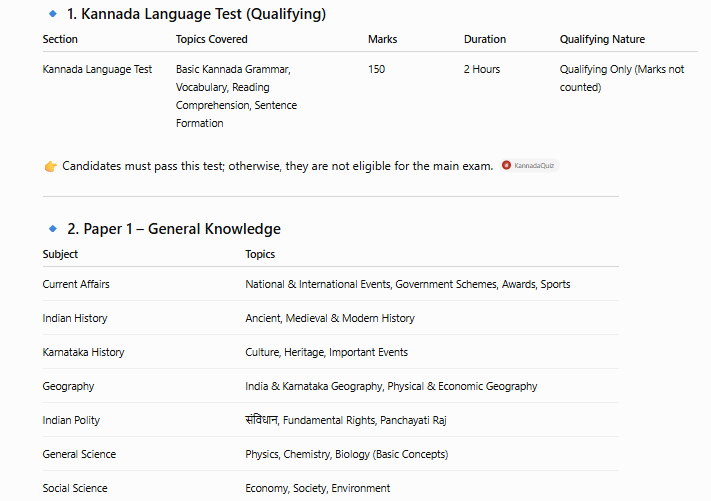
Karnataka KEA VAO Syllabus 2026: Kannada Language Test (Qualifying)
| Section | Topics Covered | Marks | Duration | Qualifying Nature |
|---|---|---|---|---|
| Kannada Language Test | Basic Kannada Grammar, Vocabulary, Reading Comprehension, Sentence Formation | 150 | 2 Hours | Qualifying Only (Marks not counted) |
Candidates must pass this test; otherwise, they are not eligible for the main exam.
Karnataka KEA VAO Syllabus 2026: Paper 1 – General Knowledge
| Subject | Topics |
|---|---|
| Current Affairs | National & International Events, Government Schemes, Awards, Sports |
| Indian History | Ancient, Medieval & Modern History |
| Karnataka History | Culture, Heritage, Important Events |
| Geography | India & Karnataka Geography, Physical & Economic Geography |
| Indian Polity | संविधान, Fundamental Rights, Panchayati Raj |
| General Science | Physics, Chemistry, Biology (Basic Concepts) |
| Social Science | Economy, Society, Environment |
| Mental Ability | Reasoning, Analytical Ability, Logical Thinking |
| Paper | Marks | Duration |
|---|---|---|
| Paper 1 (GK) | 100 | 2 Hours |
Karnataka KEA VAO Syllabus 2026: Paper 2 – Language (Choose One)
| Subject Option | Topics Covered |
|---|---|
| General Kannada | Grammar, Vocabulary, Synonyms, Antonyms, Comprehension |
| General English | Grammar, Vocabulary, Sentence Correction, Synonyms/Antonyms, Translation |
| Paper | Marks | Duration |
|---|---|---|
| Paper 2 (Language) | 100 | 2 Hours |
KEA VAO Syllabus 2026 in Detail
The official notification outlines broad areas. Detailed topic lists below are compiled from consistent reports of the syllabus structure across recruitment portals (aligned with prior VAO patterns and the 2026 notification descriptions). Focus heavily on Karnataka-specific content, as it forms a large portion of Paper 1.
Paper 1: General Knowledge (100 Marks)
Key areas (approximate emphasis based on typical weightage in similar exams):
- Current Affairs (National & International, with Karnataka focus): News of the last 12–18 months; major political developments, appointments, summits; sports events and awards (Nobel, Padma, National Sports Awards); important days, books & authors; science & technology updates; environmental issues and climate summits; Central schemes (e.g., PM-KISAN, Ayushman Bharat) and Karnataka schemes (e.g., Anna Bhagya, Ksheera Bhagya).
- General Science & Everyday Awareness: Basic Physics, Chemistry, Biology concepts relevant to daily life; social, economic, and environmental awareness; simple comprehension and information extraction; Indian society, culture, and ethics.
- Indian Constitution: Preamble, Fundamental Rights & Duties, Directive Principles of State Policy; structure of government (Parliament, President, PM, Judiciary); amendments, emergency provisions, federalism; Centre–State relations (Karnataka context).
- History of India with Special Reference to Karnataka: Ancient Karnataka (Kadambas, Gangas, Chalukyas, Rashtrakutas); Medieval (Hoysalas, Vijayanagara Empire, Bahmani Kingdom); Modern history and Freedom Struggle; Mysore Kingdom, Tipu Sultan, Kittur Rani Chennamma, Halagali Bedas; Karnataka Unification (1956).
- Geography of India in Relation to Karnataka: Physical features (Western Ghats/Malnad, Bayaluseeme plains, Karavali coast); major rivers and dams (Cauvery, Krishna, Tungabhadra, Sharavati); climate, rainfall, soil types (red, black, laterite); agriculture and crops (ragi, coffee, sugarcane, sericulture); minerals (iron ore, manganese); forests and wildlife sanctuaries (Bandipur, Nagarhole, Anshi); Karnataka’s location, borders, 31 districts, and administrative divisions.
- State & Territorial Administration / Panchayat Raj: Karnataka Government structure (Governor, CM, Council of Ministers); three-tier Panchayat Raj system (Gram/Taluk/Zilla Panchayat, 73rd Amendment); Revenue administration (Village Accountant/VAO duties, land records like RTC/Pahani, mutation, survey & settlement); local governance and decentralization.
- Karnataka Economy, Rural Development & Co-operatives: Overview of state economy (agriculture, IT, industry); rural development schemes (MGNREGA, NRLM, Stree Shakti, watershed management); role of Panchayat Raj Institutions; rural co-operatives (Nandini dairy, credit societies, handlooms, fisheries); rural infrastructure, Jal Jeevan Mission, housing/sanitation programs; environmental issues and development of Karnataka.
Paper 1 has a strong Karnataka-centric tilt (often 60%+ of questions). Geography of Karnataka and Panchayat Raj/Rural Development/Co-operatives typically carry high weightage.
Paper 2: General Kannada, General English & Computer Knowledge (100 Marks)
Roughly balanced across the three sections (approx. 30–40 questions each for languages; 25–35 for Computer in typical distributions).
General Kannada:
- Grammar (Vyakarana): Sandhi, Samasa, Linga-Vachana, Vibhakti Pratyaya, Kriya Padagalu, Visheshana-Vishesha, Karaka.
- Vocabulary: Synonyms (Paryaya Padagalu), antonyms (Viloma Padagalu), proverbs (Gadegalu/Sametegalu), idioms (Muhavaregalu), Tadbhava–Tatsama words.
- Comprehension: Passage reading (news, literature, rural themes), main idea, inference.
- Sentence skills: Formation/correction, fill-in-the-blanks, error spotting, rearrangement.
- Basics of literature/culture: Key figures (Kuvempu, Shivaram Karanth, Pampa); school-level (SSLC) grammar and rural proverbs.
General English:
- Grammar: Tenses, articles, prepositions, subject-verb agreement, active/passive voice, direct/indirect speech, conditionals.
- Vocabulary: Synonyms/antonyms, one-word substitutions, idioms & phrases, phrasal verbs, spelling correction.
- Comprehension: Short passages (main idea, inference, vocabulary-in-context).
- Other: Error spotting, sentence correction/improvement, jumbled sentences, cloze test.
Computer Knowledge:
- Fundamentals: Generations of computers, types, hardware (CPU, I/O devices, RAM/ROM/HDD/SSD), software (system vs. application).
- Operating systems: Windows basics (File Explorer, Control Panel, Task Manager), file management.
- MS Office: Word (formatting, tables, mail merge), Excel (basic formulas like SUM/AVERAGE, charts), PowerPoint (slides, transitions).
- Internet & networking: WWW, browsers, email (compose/send/attach), search engines, URL/HTTP basics.
- Cybersecurity: Viruses/malware, antivirus, firewalls, password safety, phishing, data backup.
- Miscellaneous: Keyboard shortcuts, file extensions (.docx, .xlsx, .pdf), common abbreviations (CPU, RAM, URL), Digital India basics.
Preparation Tips
- Prioritize Karnataka Geography, Panchayat Raj/Rural Development, and state-specific current affairs for Paper 1 — these are high-yield.
- Build a fact sheet of districts, rivers/dams, schemes, and key historical events; revise regularly.
- For languages, strengthen SSLC-level Kannada grammar and common English error-spotting rules.
- Computer Knowledge is generally scoring with focused practice on basics and MS Office.
- Practice previous years’ KEA VAO/Village Accountant papers and timed mocks while strictly observing negative marking (avoid random guessing).
- For the Compulsory Kannada Test (if applicable), treat it as essential — failing it disqualifies you regardless of written scores.
- Official notifications and any syllabus PDFs are available on the KEA website (cetonline.karnataka.gov.in/kea). Cross-check the exact wording in the latest notification for any minor updates.
This structure prepares candidates effectively for the grassroots administrative role involving land records, revenue collection, certificates, and rural scheme implementation. Stay updated via the official KEA portal for admit cards, exact schedules, and any refinements to the syllabus or pattern. Good luck with your preparation!
About The Author
