
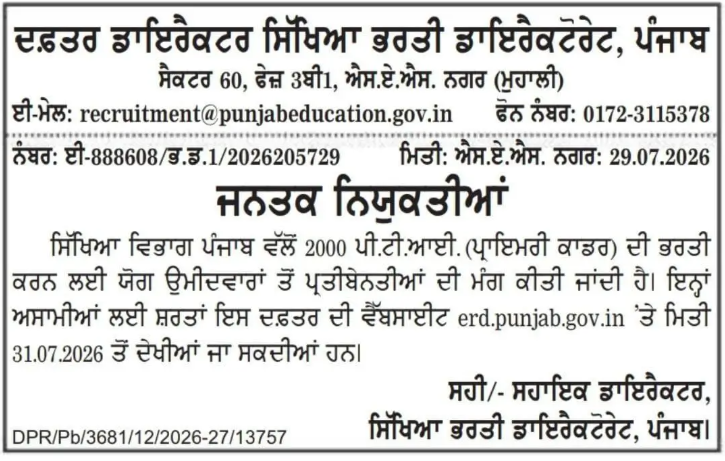
Punjab PTI Syllabus 2026: The Punjab Physical Training Instructor (PTI) exam recruits candidates for teaching physical education in government schools (primarily elementary/primary cadre, Classes I–V). The 2025 recruitment for 2,000 posts (advertised around July 2025 by the Directorate of School Education/Education Recruitment Board) was later withdrawn/cancelled. As of mid-2026, A fresh official notification with a confirmed syllabus for a new drive has been widely published. Qualification norms under the Punjab State Elementary Education (Physical Training Instructor) Service Rules, 2023 (as amended) continue to emphasise DPEd/CPEd (or equivalent) as appropriate for primary-level posts.
Candidates should treat the details below as the Punjab PTI Syllabus 2026 drawn from coaching analyses of prior related recruitments, PSSSB-style papers, and PE-focused syllabi (including related posts such as Hostel Superintendent-cum-PTI). Always verify against the latest official notification on sites such as sssb.punjab.gov.in, educationrecruitmentboard.com, or the Punjab School Education Department portal when a new advertisement appears.
Punjab PTI Recruitment: Overview
- Post: Physical Training Instructor (PTI) – Elementary/Primary Cadre
- Conducting Body: Typically Punjab Education Recruitment Board / Directorate of School Education or PSSSB
- Key Qualification (as retained in rules): 10+2 + two-year Diploma/Certificate in Physical Education (DPEd/CPEd or equivalent nomenclature); alternatives such as integrated BPEd or graduation with PE + relevant diploma may apply depending on the specific advertisement. Age generally 18–37 years (with relaxations).
- Pay: Around ₹29,200/- (level as per rules, subject to revision).
- Official Sources to Monitor: sssb.punjab.gov.in, relevant education department portals.
Punjab PTI Selection Process 2026
- Written Examination (objective MCQs; often two papers).
- Physical Eligibility Test (PET) – qualifying in nature (candidates usually need to clear a minimum number of components; PwD exemptions may apply).
- Sports Achievement/Gradation marks (where applicable, up to a fixed weightage).
- Document Verification + Medical Examination.
- Punjabi language qualifying paper (Matric level, often mandatory with minimum percentage).
Final merit is commonly based on written exam + sports marks (e.g., 70 + 30 in some earlier frameworks). Exact weightage is notification-specific.
Punjab PTI Exam Pattern 2026
Most analyses project a two-paper written exam (objective type). Duration is typically 120 minutes per paper.
Paper 1 (General)
| Subject | No. of Questions | Marks |
|---|---|---|
| Geographical, Historical, Cultural & General Knowledge of Punjab | 40 | 80 |
| Current Affairs of Punjab | 10 | 20 |
| General Knowledge of World and India | 30 | 60 |
| Educational Psychology | 20 | 40 |
| Total | 100 | 200 |
Paper 2 (Physical Education)
| Subject | No. of Questions | Marks |
|---|---|---|
| Physical Education | 130 | 260 |
| Total | 130 | 260 |
- Mode: Offline (OMR) or as notified.
- Question Type: Multiple-choice.
- Language: Likely English and Punjabi (or as specified).
Some related frameworks use a single written paper of lower total marks (e.g., 70) plus sports weightage; the two-paper structure above is the most commonly cited expected pattern for PTI Teacher posts.
Punjab PTI Marking Scheme 2026
- Correct answer: Usually +2 marks per question in the projected Paper 1/2 pattern (leading to the totals above), or +1 in single-paper variants.
- Negative marking: Often absent or minimal (e.g., 0.25 in some PSSSB exams); confirm in the official notification.
- Qualifying elements: PET and Punjabi paper are typically qualifying only and do not add to merit (or have separate thresholds).
- Sports marks (if applicable): Graded certificates (A/B/C etc.) convert to a fixed maximum (commonly 30).
Punjab PTI Syllabus 2026 Paper 1: General Awareness Syllabus
| Section | Topics Covered |
|---|---|
| General Knowledge (India & World) | History, Geography, Polity, Economy, Science & Technology, Environment |
| Current Affairs | National & International events, Sports, Awards, Important Days |
| Punjab GK | History of Punjab, Culture, Language, Literature, Sikh Gurus, Freedom Movement |
| Punjab Culture & Society | Social, religious & economic life, Bhakti Movement, Sufism |
| Educational Psychology | Learning theories, Teaching methods, Child development |
| Miscellaneous | Books & Authors, Important Personalities, Government Schemes |
Punjab PTI Syllabus 2026 Paper 2: Physical Education Syllabus
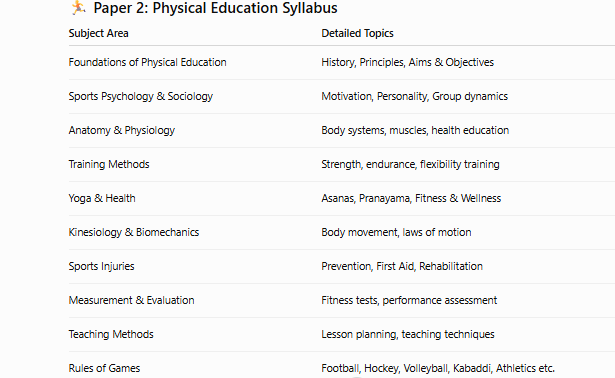
| Subject Area | Detailed Topics |
|---|---|
| Foundations of Physical Education | History, Principles, Aims & Objectives |
| Sports Psychology & Sociology | Motivation, Personality, Group dynamics |
| Anatomy & Physiology | Body systems, muscles, health education |
| Training Methods | Strength, endurance, flexibility training |
| Yoga & Health | Asanas, Pranayama, Fitness & Wellness |
| Kinesiology & Biomechanics | Body movement, laws of motion |
| Sports Injuries | Prevention, First Aid, Rehabilitation |
| Measurement & Evaluation | Fitness tests, performance assessment |
| Teaching Methods | Lesson planning, teaching techniques |
| Rules of Games | Football, Hockey, Volleyball, Kabaddi, Athletics etc. |
Key Highlights
- Paper 1 focuses on Punjab-specific knowledge + general awareness
- Paper 2 is high-weightage (major marks) and purely subject-based
- Questions are objective (MCQ type)
- Syllabus is based on Diploma/Degree level Physical Education concepts
Paper 1 Topics
- General Knowledge & Current Affairs (National/International + Punjab focus): Polity, Environment, Economy, Science & Technology, History of India (with freedom struggle), Sports, Cinema & Literature, Geography.
- Punjab History & Culture: Physical features and ancient history of Punjab; social, religious and economic life; language, literature and arts; Afghan/Mughal period; Bhakti Movement and Sufism; Sikh Gurus, Saints, Adi Granth; Sikh rulers; freedom movements in Punjab.
- Educational Psychology: Learning theories, motivation, personality, child development, teaching-learning processes, classroom management, individual differences, etc.
Paper 2 – Physical Education (Core)
- History & Principles of Physical Education (aims, objectives, development in India pre- and post-independence, modern importance).
- Sports Psychology and Sociology.
- Anatomy, Physiology and Health Education (body systems – circulatory, muscular, excretory, nervous, respiratory, digestive; growth & development; communicable diseases; personal health; balanced diet; effects of intoxicants).
- Training Methods and Rules of Games.
- Yoga, First Aid and Teaching Techniques.
- Kinesiology and Biomechanics.
- Sports Injuries and Rehabilitation (prevention, common injuries such as muscle pulls, fractures, dislocations; first aid).
- Measurement and Evaluation in Physical Education.
- Rules and Techniques of Major Games (Football, Hockey, Volleyball, Kabaddi, Athletics, Basketball, Badminton, Cricket, Handball, Kho-Kho, Wrestling, etc.).
- Physical Fitness, methods of training, warm-up/cool-down; Sports Management & Organisation of events; Olympic/Asian/Commonwealth Games; Sports Awards; Punjab sports bodies.
Related official PE syllabi (e.g., for Hostel Superintendent-cum-PTI) cover nearly identical topics and can be used for focused preparation.
Punjab PTI Syllabus 2026 PDF Download
No single official 2026 PTI syllabus PDF is currently active on major government portals because a fresh recruitment notification has not been issued.
- Check sssb.punjab.gov.in (Syllabus section) and the Education Recruitment Board / SSA Punjab portals regularly.
- Coaching/educational sites host compiled “expected” PDFs based on the topics above; treat them as secondary sources only.
- For related PE content, older SSSB annexures for PE posts provide useful topic lists.
Tip: When the official advertisement is released, the syllabus is almost always attached as an annexure or linked PDF—download it immediately and ignore unofficial versions if they differ.
Preparation Tips
- Prioritise Paper 2 (Physical Education) as it carries higher weightage.
- Strengthen Punjab GK, history, culture and current affairs (especially sports-related).
- Practice MCQs from previous teaching/PE exams and standard DPEd/BPEd textbooks.
- Include PET practice early (running, jumps, shuttle runs, flexibility as per typical male/female norms).
- Stay updated via official websites and authentic current-affairs sources focused on Punjab and national sports.
About The Author
