
The Kuwait Grade 2 Islamic Education Curriculum 2026–27 is designed by the Ministry of Education to nurture strong Islamic values, moral character, and foundational religious knowledge among young learners. At this stage, students are introduced to basic concepts of faith (Aqeedah), worship (Fiqh), Quran, Hadith, and Seerah, using simple language, stories, and practical activities.
The curriculum follows a competency-based approach, aiming to help students connect Islamic teachings with their daily lives and behavior.
Kuwait Grade 2 Islamic Education Curriculum 2026-27: Objectives of Islamic Education (Primary Level)
By the end of primary education, including Grade 2, students are expected to:
- Understand the pillars of Islam and faith
- Practice basic acts of worship such as prayer and ablution
- Apply Islamic morals and manners in daily life
- Learn from the life of Prophet Muhammad (PBUH) and companions
- Develop positive social behavior and responsibility
- Recognize the importance of ethics, honesty, and kindness
Core Subjects Covered in Grade 2 Islamic Education
The curriculum is divided into structured domains:
| Subject Area | Focus |
|---|---|
| Quran الكريم | Memorization, recitation, and understanding |
| Aqeedah (Faith) | Belief in Allah and reliance on Him |
| Hadith (Prophetic Sayings) | Daily supplications and moral teachings |
| Fiqh (Islamic Practices) | Prayer rules and cleanliness |
| Seerah (Biography of Prophet) | Life events and character of Prophet Muhammad (PBUH) |
| Akhlaq (Manners) | Good behavior, ethics, and social values |
Kuwait Grade 2 Islamic Education Curriculum 2026-27
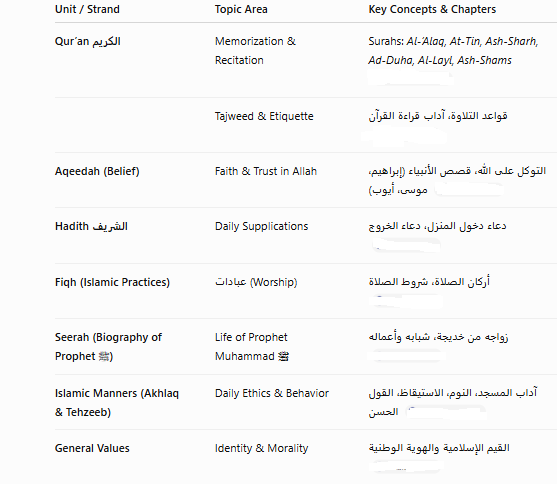
| Unit / Strand | Topic Area | Key Concepts & Chapters | Learning Outcomes |
|---|---|---|---|
| Qur’an الكريم | Memorization & Recitation | Surahs: Al-‘Alaq, At-Tin, Ash-Sharh, Ad-Duha, Al-Layl, Ash-Shams | – Memorize short surahs correctly – Recite with basic Tajweed – Understand simple meanings |
| Tajweed & Etiquette | قواعد التلاوة، آداب قراءة القرآن | – Follow proper recitation manners – Practice correct pronunciation |
|
| Aqeedah (Belief) | Faith & Trust in Allah | التوكل على الله، قصص الأنبياء (إبراهيم، موسى، أيوب) | – Strengthen belief in Allah – Learn reliance on Allah through stories |
| Hadith الشريف | Daily Supplications | دعاء دخول المنزل، دعاء الخروج | – Memorize short duas – Apply in daily life |
| Fiqh (Islamic Practices) | عبادات (Worship) | أركان الصلاة، شروط الصلاة | – Understand importance of prayer – Perform prayer correctly |
| Seerah (Biography of Prophet ﷺ) | Life of Prophet Muhammad ﷺ | زواجه من خديجة، شبابه وأعماله | – Learn key events of Prophet’s life – Develop love and respect for Prophet |
| Islamic Manners (Akhlaq & Tehzeeb) | Daily Ethics & Behavior | آداب المسجد، النوم، الاستيقاظ، القول الحسن | – Practice good manners – Apply Islamic values in daily routines |
| General Values | Identity & Morality | القيم الإسلامية والهوية الوطنية | – Build moral character – Connect Islamic values with society |
Weekly Distribution (Overview)
| Component | Approx. Coverage |
|---|---|
| Qur’an Memorization | ~4 units across 16 weeks |
| Islamic Studies (Aqeedah, Hadith, Fiqh, Seerah) | Integrated across lessons |
| Activities & Practice | Story-based + daily life application |
1. Quran & Tajweed
- Memorization of short Surahs such as:
- Surah Al-‘Alaq
- Surah At-Tin
- Surah Ash-Sharh
- Surah Ad-Duha
- Surah Al-Layl
- Surah Ash-Shams
- Basic Tajweed rules (pronunciation of letters like Meem, Noon, etc.)
- Understanding general meanings of verses
- Learning etiquette of Quran recitation (cleanliness, respect)
2. Aqeedah (Islamic Beliefs)
- Concept of Tawakkul (trust in Allah)
- Stories of Prophets (e.g., Ibrahim, Musa, Ayyub) to explain faith
- Understanding that Allah is the protector and creator
- Building a strong emotional connection with faith
3. Hadith & Daily Supplications
- Memorization of simple Hadith
- Daily duas such as:
- Dua for entering the house
- Dua for leaving the house
- Importance of remembering Allah in daily life
- Applying Hadith in behavior (kindness, truthfulness)
4. Fiqh (Islamic Practices)
- Learning pillars of Salah (prayer)
- Correct method of Wudu (ablution)
- Importance of cleanliness and discipline
- Understanding why prayer is important
5. Seerah (Life of Prophet Muhammad PBUH)
- Key events such as:
- Marriage of Prophet Muhammad (PBUH) to Khadijah (RA)
- Learning from Prophet’s honesty, kindness, and patience
- Introducing Islamic role models
6. Akhlaq (Manners & Ethics)
- Manners of:
- Sleeping and waking
- Visiting the mosque
- Speaking good words (“Say only الخير”)
- Respect for parents, teachers, and others
- Building positive social habits
Term-Wise Curriculum Overview
| Term | Key Focus Areas |
|---|---|
| Term 1 | Basic beliefs, simple duas, introduction to prayer, early Seerah |
| Term 2 | Quran memorization, deeper moral lessons, practical worship skills |
Teaching Methodology
The Kuwait curriculum uses modern teaching strategies such as:
- Storytelling (Qisas) for understanding prophets
- Activity-based learning (role play, recitation practice)
- Visual aids and illustrations for Quran understanding
- Repetition and memorization for Surahs and Hadith
- Real-life application of Islamic values
These methods ensure children not only learn but also practice Islam in daily life.
Assessment & Evaluation
Students are assessed through:
- Oral recitation of Quran and Hadith
- Practical demonstration (Wudu, Salah)
- Class participation and behavior
- Simple written or verbal tests
Focus is on understanding and application, not just memorization.
Key Learning Outcomes
By the end of Grade 2, students will:
- Memorize selected short Surahs correctly
- Perform basic Islamic practices like prayer
- Demonstrate good manners and discipline
- Understand simple Islamic beliefs
- Show respect, honesty, and responsibility
Conclusion
The Kuwait Grade 2 Islamic Education Curriculum 2026–27 plays a vital role in shaping a child’s religious identity, moral values, and social behavior. It blends Quranic learning, practical worship, and ethical development in an engaging and age-appropriate way. By focusing on both knowledge and practice, the curriculum ensures that students grow into responsible individuals guided by Islamic principles, forming a strong foundation for future learning and character building.
About The Author
