
The Kuwait Grade 3 Arabic Curriculum 2026-27 is designed to strengthen foundational language skills while gradually introducing more advanced reading, writing, grammar, and communication abilities. At this stage, students transition from basic literacy to structured language learning, focusing on comprehension, expression, and cultural appreciation.
The curriculum aligns with national education standards set by the Ministry of Education Kuwait, ensuring that students develop strong proficiency in Modern Standard Arabic (MSA).
Key Learning Objectives
By the end of Grade 3, students are expected to:
- Read and understand short paragraphs and stories
- Write simple sentences and short compositions
- Apply basic grammar rules correctly
- Expand vocabulary across everyday topics
- Develop listening and speaking skills for communication
- Appreciate Arabic culture, values, and literature
Kuwait Grade 3 Arabic Curriculum 2026–27
Aspirant-friendly Kuwait Grade 3 Arabic Curriculum (2026–27) presented in a tabular format based on the official Ministry-aligned textbooks and curriculum distribution.
Term 1 Curriculum
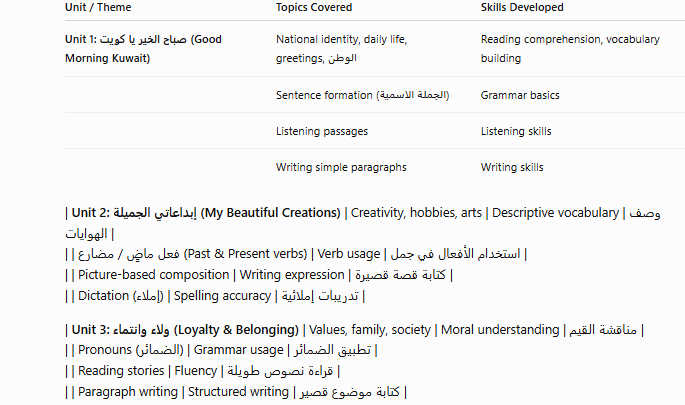
| Unit / Theme | Topics Covered | Skills Developed | Activities / Outcomes |
|---|---|---|---|
| Unit 1: صباح الخير يا كويت (Good Morning Kuwait) | National identity, daily life, greetings, الوطن | Reading comprehension, vocabulary building | قراءة نصوص عن الكويت، التعبير الشفهي |
| Sentence formation (الجملة الاسمية) | Grammar basics | تكوين جمل بسيطة | |
| Listening passages | Listening skills | فهم المسموع والإجابة | |
| Writing simple paragraphs | Writing skills | كتابة فقرة عن الوطن |
| Unit 2: إبداعاتي الجميلة (My Beautiful Creations) | Creativity, hobbies, arts | Descriptive vocabulary | وصف الهوايات |
| | فعل ماضٍ / مضارع (Past & Present verbs) | Verb usage | استخدام الأفعال في جمل |
| | Picture-based composition | Writing expression | كتابة قصة قصيرة |
| | Dictation (إملاء) | Spelling accuracy | تدريبات إملائية |
| Unit 3: ولاء وانتماء (Loyalty & Belonging) | Values, family, society | Moral understanding | مناقشة القيم |
| | Pronouns (الضمائر) | Grammar usage | تطبيق الضمائر |
| | Reading stories | Fluency | قراءة نصوص طويلة |
| | Paragraph writing | Structured writing | كتابة موضوع قصير |
These three units are officially part of the Grade 3 Arabic textbook for Term 1.
Term 2 Curriculum
| Unit / Theme | Topics Covered | Skills Developed | Activities / Outcomes |
|---|---|---|---|
| Unit 4: البيئة من حولي (Environment Around Me) | Nature, environment, cleanliness | Vocabulary enrichment | وصف البيئة |
| Imperative verbs (فعل الأمر) | Grammar | استخدام الأوامر | |
| Reading comprehension | Analytical skills | الإجابة عن الأسئلة |
| Unit 5: صحتي وسلامتي (Health & Safety) | Hygiene, safety rules | Functional language | نصائح وإرشادات |
| | Negation tools (النفي) | Grammar | استخدام أدوات النفي |
| | Listening & speaking | Communication skills | حوارات |
| Unit 6: العلم نور (Knowledge is Light) | Education, school life | Informational reading | تلخيص نص |
| | Prepositions (حروف الجر) | Grammar usage | تكوين جمل صحيحة |
| | Creative writing | Expression | كتابة موضوع عن المدرسة |
The Term 2 curriculum follows an official distribution plan by Kuwait MOE guidance.
Core Language Skill Areas
| Skill Area | Key Focus |
|---|---|
| Reading (القراءة) | فهم النصوص، الطلاقة، تحليل المعنى |
| Writing (الكتابة) | كتابة جمل وفقرات، التعبير الإبداعي |
| Grammar (القواعد) | الأفعال، الضمائر، حروف الجر، التراكيب |
| Listening (الاستماع) | فهم المسموع والإجابة |
| Speaking (التحدث) | التعبير الشفهي، الحوار |
High-Weightage Topics
- قراءة وفهم النصوص (Comprehension)
- تكوين الجملة (Sentence formation)
- الأفعال (Past / Present / Imperative)
- الضمائر وحروف الجر
- التعبير الكتابي (Paragraph writing)
- الإملاء (Dictation)
Assessment Pattern (General)
| Component | Weightage |
|---|---|
| Reading & Comprehension | High |
| Writing Skills | High |
| Grammar | Medium |
| Listening & Speaking | Medium |
| Dictation | Low–Medium |
Curriculum Structure (Subject-Wise Breakdown)
1. Reading Skills (القراءة)
Reading is a central component aimed at improving fluency and comprehension.
Topics Covered:
- قراءة الجمل والفقرات القصيرة (Reading sentences and short paragraphs)
- فهم المعنى العام للنص (Understanding main ideas)
- الإجابة على أسئلة الفهم (Comprehension questions)
- قراءة القصص القصيرة (Short stories and narratives)
- التمييز بين الكلمات المتشابهة (Word recognition and differentiation)
Skills Developed:
- Fluency in reading aloud
- Identifying key ideas
- Vocabulary recognition
2. Writing Skills (الكتابة)
Writing focuses on sentence formation and structured expression.
Topics Covered:
- كتابة الجمل البسيطة (Simple sentence writing)
- تكوين فقرات قصيرة (Paragraph writing)
- استخدام علامات الترقيم (Punctuation usage)
- كتابة موضوعات قصيرة (Short compositions like “My School”, “My Family”)
Skills Developed:
- Clear handwriting
- Logical sentence structure
- Expression of ideas
3. Grammar (القواعد)
Grammar introduces essential rules of sentence construction.
Topics Covered:
- الاسم والفعل والحرف (Nouns, verbs, particles)
- الجملة الاسمية والفعلية (Nominal and verbal sentences)
- التذكير والتأنيث (Masculine and feminine forms)
- المفرد والجمع (Singular and plural forms)
- الضمائر الأساسية (Basic pronouns)
Skills Developed:
- Sentence accuracy
- Proper word usage
- Understanding structure
4. Vocabulary Development (المفردات)
Vocabulary is expanded through themes and daily-life contexts.
Topics Covered:
- مفردات الأسرة (Family vocabulary)
- المدرسة (School-related words)
- الحيوانات (Animals)
- الطعام والشراب (Food and drinks)
- البيئة (Environment)
Skills Developed:
- Word recognition
- Contextual usage
- Speaking confidence
5. Listening & Speaking (الاستماع والتحدث)
This section enhances communication and pronunciation.
Topics Covered:
- الاستماع للنصوص القصيرة (Listening to short passages)
- التعبير الشفوي (Oral expression)
- المحادثات اليومية (Daily conversations)
- سرد القصص (Storytelling)
Skills Developed:
- Pronunciation accuracy
- Confidence in speaking
- Listening comprehension
Teaching Methodology
The curriculum uses modern, student-centered approaches:
- Activity-based learning
- Storytelling and role play
- Visual aids and flashcards
- Group discussions
- Digital learning tools
Importance of Arabic in Grade 3
Arabic is not only a subject but also a medium for cultural and moral education in Kuwait. It helps students:
- Connect with Arab heritage and identity
- Understand religious and cultural texts
- Build strong communication skills for future education
Conclusion
The Kuwait Grade 3 Arabic Curriculum 2026–27 provides a balanced approach to language learning by integrating reading, writing, grammar, vocabulary, and communication skills. With a strong foundation built at this stage, students are well-prepared for advanced language learning in higher grades while maintaining a deep connection to their linguistic and cultural roots.
About The Author
