
The Kuwait Grade 3 English Curriculum 2026–27 is designed to strengthen students’ foundational language abilities while introducing more structured grammar, reading, and communication skills. Developed under the Kuwait Ministry of Education, the curriculum aligns with global standards and focuses on improving students’ proficiency in listening, speaking, reading, and writing.
It emphasizes real-life communication, cultural awareness, and gradual progression in grammar and vocabulary to prepare learners for higher primary grades.
Kuwait Grade 3 English Curriculum 2026-27 Objectives
The main goals of the Grade 3 English curriculum include:
- Developing basic communication skills in English
- Enhancing reading comprehension and fluency
- Building correct sentence formation and grammar usage
- Encouraging creative writing and expression
- Promoting confidence in speaking and listening
The curriculum aims to make English learning interactive, engaging, and practical for everyday use.
Key Units & Themes
The syllabus is usually divided into thematic units that connect language learning with real-life contexts. One example includes the unit “All About Kuwait,” which introduces vocabulary and grammar through local context and culture.
Major Themes Covered:
- All About Kuwait (culture, places, identity)
- Family and Friends
- School Life
- Animals and Nature
- Travel and Daily Activities
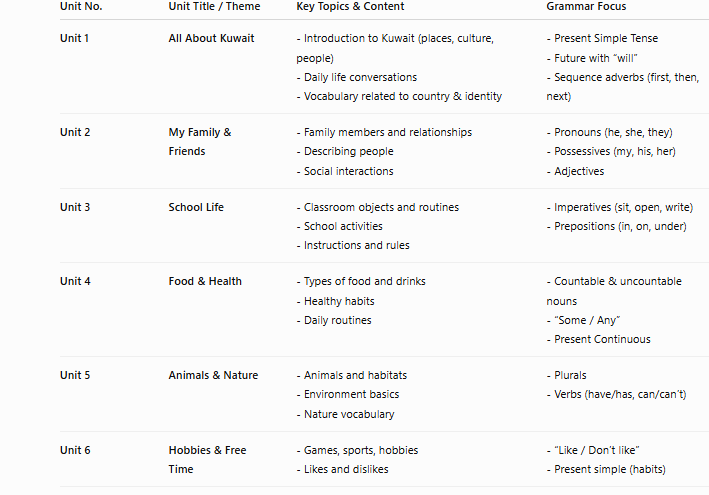
Kuwait Grade 3 English Curriculum 2026–27 (Unit-wise)
Kuwait Grade 3 English Curriculum 2026–27 (Unit-wise) presented in a clear format based on available Ministry-aligned textbook structure and themes.
| Unit No. | Unit Title / Theme | Key Topics & Content | Grammar Focus | Skills Developed |
|---|---|---|---|---|
| Unit 1 | All About Kuwait | – Introduction to Kuwait (places, culture, people) – Daily life conversations – Vocabulary related to country & identity |
– Present Simple Tense – Future with “will” – Sequence adverbs (first, then, next) |
– Speaking about self & country – Reading short passages – Listening comprehension |
| Unit 2 | My Family & Friends | – Family members and relationships – Describing people – Social interactions |
– Pronouns (he, she, they) – Possessives (my, his, her) – Adjectives |
– Descriptive writing – Conversation skills – Vocabulary building |
| Unit 3 | School Life | – Classroom objects and routines – School activities – Instructions and rules |
– Imperatives (sit, open, write) – Prepositions (in, on, under) |
– Following instructions – Reading dialogues – Writing simple sentences |
| Unit 4 | Food & Health | – Types of food and drinks – Healthy habits – Daily routines |
– Countable & uncountable nouns – “Some / Any” – Present Continuous |
– Speaking about habits – Writing short paragraphs – Listening for details |
| Unit 5 | Animals & Nature | – Animals and habitats – Environment basics – Nature vocabulary |
– Plurals – Verbs (have/has, can/can’t) |
– Reading stories – Describing animals – Creative expression |
| Unit 6 | Hobbies & Free Time | – Games, sports, hobbies – Likes and dislikes |
– “Like / Don’t like” – Present simple (habits) |
– Speaking fluently – Writing about hobbies |
| Unit 7 | Travel & Places | – Places in town – Directions – Simple travel conversations |
– Prepositions of place – Question forms (Where, How) |
– Asking/answering questions – Map reading skills |
| Unit 8 | The World Around Us | – Weather and seasons – Basic science vocabulary – Global awareness |
– Adjectives – Simple comparisons (hot/cold, big/small) |
– Observation skills – Descriptive speaking |
Key Features of the Kuwait Grade 3 English Curriculum
- Focus on basic communication and vocabulary building
- Integration of reading, writing, listening, and speaking skills
- Use of real-life themes (family, school, environment)
- Gradual introduction to English grammar concepts
- Activity-based learning approach to improve language fluency
Learning Outcomes
By the end of Grade 3, students are expected to:
- Read and understand short stories and simple texts
- Write basic sentences and short paragraphs
- Communicate in simple everyday English
- Use basic grammar correctly in context
Language Skills Development
1. Listening Skills
- Understanding simple instructions and classroom language
- Listening to short stories and conversations
- Identifying key words and main ideas
2. Speaking Skills
- Introducing themselves and others
- Describing people, places, and objects
- Participating in short conversations and role-plays
3. Reading Skills
- Reading short paragraphs and stories
- Recognizing sight words and phonics patterns
- Answering comprehension questions
4. Writing Skills
- Writing simple sentences and short paragraphs
- Using punctuation (capital letters, full stops, question marks)
- Describing pictures and daily activities
Grammar & Vocabulary Topics
The Grade 3 curriculum introduces structured grammar concepts such as:
Grammar Topics:
- Present Simple Tense
- Future tense (using “will”)
- Use of adverbs of sequence (first, then, next)
- Nouns (common & proper)
- Pronouns
- Adjectives
- Prepositions (in, on, under, etc.)
- Basic sentence structure
Vocabulary Development:
- Everyday words (home, school, food, animals)
- Action verbs
- Descriptive words
- Thematic vocabulary linked to units
Teaching Methodology
The curriculum follows a student-centered and activity-based approach, including:
- Storytelling and reading aloud
- Group discussions and role-play
- Visual aids (flashcards, pictures, videos)
- Phonics-based learning
- Interactive worksheets and exercises
This approach ensures that students learn English in a fun and meaningful way.
Assessment & Evaluation
Assessment in Grade 3 is continuous and focuses on overall development:
- Formative Assessment: classwork, participation, oral activities
- Summative Assessment: tests, quizzes, reading and writing tasks
- Project Work: simple presentations or creative assignments
The focus is on skill development rather than rote learning.
Sample Curriculum Structure
| Component | Topics/Skills Covered | Learning Outcome |
|---|---|---|
| Reading | Short stories, comprehension | Understand basic texts |
| Writing | Sentences, short paragraphs | Express ideas clearly |
| Grammar | Tenses, nouns, pronouns, adjectives | Use correct language structures |
| Vocabulary | Daily life words, thematic vocabulary | Build word bank |
| Speaking | Conversations, descriptions | Communicate confidently |
| Listening | Instructions, stories | Improve understanding |
Curriculum Approach & Modernization
Kuwait’s education system is actively modernizing its curriculum to align with international standards and future skills. Educational reforms focus on improving engagement, incorporating feedback, and enhancing learning outcomes across subjects.
Conclusion
The Kuwait Grade 3 English Curriculum 2026–27 provides a balanced and structured approach to language learning. By combining grammar, vocabulary, and communication skills with engaging themes and activities, it helps students build a strong English foundation. The curriculum not only improves academic performance but also prepares learners to use English confidently in real-life situations and future studies.
About The Author
