
The Kuwait Grade 3 Mathematics Curriculum (2026–27) is designed to strengthen foundational numeracy while introducing students to more advanced concepts like multiplication, fractions, measurement, and geometry. Although Kuwait’s exact curriculum framework may vary slightly across schools (public, private, and international), it closely aligns with global primary math standards.
At this stage, students typically move from basic arithmetic to multi-digit operations, problem-solving, and real-life applications of math concepts.
Kuwait Grade 3 Mathematics Curriculum 2026-27: Overview
Grade 3 mathematics focuses on five major strands:
- Number Sense & Operations
- Algebraic Thinking
- Fractions
- Measurement & Data
- Geometry
These areas help students develop logical thinking, accuracy, and problem-solving skills.
Unit-Wise Kuwait Grade 3 Math Syllabus 2026–27
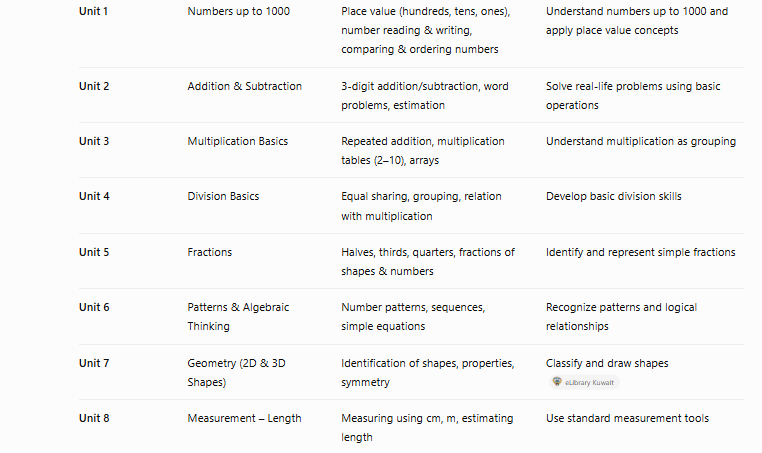
Unit-wise table for Kuwait Grade 3 Mathematics Curriculum (2026–27) based on the Kuwait Ministry framework and aligned primary math strands (numbers, geometry, measurement, data, etc.). The official Kuwait curriculum emphasizes problem-solving, number sense, measurement, geometry, and data handling.
| Unit No. | Unit Name | Key Topics / Concepts Covered | Learning Outcomes |
|---|---|---|---|
| Unit 1 | Numbers up to 1000 | Place value (hundreds, tens, ones), number reading & writing, comparing & ordering numbers | Understand numbers up to 1000 and apply place value concepts |
| Unit 2 | Addition & Subtraction | 3-digit addition/subtraction, word problems, estimation | Solve real-life problems using basic operations |
| Unit 3 | Multiplication Basics | Repeated addition, multiplication tables (2–10), arrays | Understand multiplication as grouping |
| Unit 4 | Division Basics | Equal sharing, grouping, relation with multiplication | Develop basic division skills |
| Unit 5 | Fractions | Halves, thirds, quarters, fractions of shapes & numbers | Identify and represent simple fractions |
| Unit 6 | Patterns & Algebraic Thinking | Number patterns, sequences, simple equations | Recognize patterns and logical relationships |
| Unit 7 | Geometry (2D & 3D Shapes) | Identification of shapes, properties, symmetry | Classify and draw shapes |
| Unit 8 | Measurement – Length | Measuring using cm, m, estimating length | Use standard measurement tools |
| Unit 9 | Measurement – Weight & Capacity | Grams, kilograms, liters, comparison | Apply measurement in daily life |
| Unit 10 | Time & Calendar | Reading clocks, days, months, duration | Tell time and solve time problems |
| Unit 11 | Money | Currency (Kuwaiti Dinar), addition/subtraction of money | Perform transactions and calculations |
| Unit 12 | Area & Perimeter | Counting squares, simple perimeter problems | Understand basic geometry measurements |
| Unit 13 | Data Handling | Pictographs, bar graphs, data interpretation | Organize and interpret data |
| Unit 14 | Problem Solving & Logical Reasoning | Word problems, multi-step questions | Apply mathematical thinking in real-life contexts |
Key Features of Kuwait Grade 3 Maths Curriculum
- Focus on practical application and real-life problem solving
- Emphasis on metric system, time, and money usage
- Development of logical reasoning and data interpretation skills
- Introduction to multiplication, division, and fractions as foundational concepts
Below is a detailed unit-wise breakdown of the curriculum:
Unit 1: Numbers & Place Value (Up to 1000)
Key Topics:
- Counting, reading, and writing numbers up to 1000
- Place value (hundreds, tens, ones)
- Comparing and ordering numbers
- Odd and even numbers
- Rounding to nearest 10 and 100
Learning Outcome:
Students understand number structure and develop strong number sense.
Place value and number comparison form the base for all later arithmetic skills.
Unit 2: Addition & Subtraction
Key Topics:
- Addition of 2-digit and 3-digit numbers
- Subtraction with and without borrowing
- Word problems involving real-life situations
- Estimation strategies
Learning Outcome:
Students perform accurate calculations and apply operations in daily situations.
Unit 3: Multiplication
Key Topics:
- Concept of multiplication (repeated addition)
- Times tables (2 to 10)
- Multiplication using arrays and grouping
- Multiplying single-digit and simple two-digit numbers
Learning Outcome:
Students develop foundational multiplication skills and fluency.
Grade 3 is where students begin mastering multiplication facts and strategies.
Unit 4: Division
Key Topics:
- Division as sharing and grouping
- Relationship between multiplication and division
- Simple division problems
- Division word problems
Learning Outcome:
Students understand division as the inverse of multiplication.
Unit 5: Fractions
Key Topics:
- Introduction to fractions (½, ⅓, ¼)
- Fractions as parts of a whole
- Representing fractions using shapes
- Comparing simple fractions
Learning Outcome:
Students build early understanding of fractions and equal parts.
Fractions are introduced as unit fractions and visual models.
Unit 6: Measurement
Key Topics:
- Length (cm, m)
- Weight (g, kg)
- Capacity (litres)
- Estimation and comparison
- Perimeter and introduction to area
Learning Outcome:
Students learn to measure and estimate quantities in real-life contexts.
Unit 7: Time & Money
Key Topics:
- Reading clocks (hours, minutes)
- AM and PM
- Calendar (days, months)
- Basic money calculations
Learning Outcome:
Students understand time management and practical money usage.
Telling time to the nearest minute is a key Grade 3 skill.
Unit 8: Data Handling
Key Topics:
- Picture graphs
- Bar graphs
- Collecting and interpreting data
- Simple surveys
Learning Outcome:
Students learn to organize, represent, and interpret data visually.
Unit 9: Geometry
Key Topics:
- 2D shapes (square, rectangle, triangle, circle)
- Properties of shapes (sides, angles)
- Symmetry
- Introduction to area and perimeter
Learning Outcome:
Students recognize and classify shapes and understand spatial concepts.
Geometry includes analyzing and comparing shapes based on properties.
Skills Developed in Grade 3 Mathematics
By the end of the academic year, students will be able to:
- Solve multi-step arithmetic problems
- Understand multiplication & division relationships
- Work with basic fractions
- Measure and compare quantities
- Interpret data and graphs
- Recognize geometric shapes and patterns
Suggested Term-Wise Distribution (Optional)
| Term | Units Covered |
|---|---|
| Term 1 | Numbers, Addition, Subtraction |
| Term 2 | Multiplication, Division, Fractions |
| Term 3 | Measurement, Time, Data, Geometry |
Conclusion
The Kuwait Grade 3 Mathematics Curriculum 2026–27 builds a strong bridge between basic arithmetic and advanced mathematical thinking. It emphasizes:
- Concept clarity
- Real-life application
- Problem-solving skills
By mastering these units, students gain the confidence and skills needed for higher-level mathematics in Grade 4 and beyond.
About The Author
