
The US Grade 2 Physical Education Syllabus 2026-27 school year is designed to build upon the foundational movement skills established in kindergarten and first grade. The curriculum is guided by the five National Physical Education Standards from SHAPE America (Society of Health and Physical Educators), which aim to develop “physically literate individuals who have the knowledge, skills and confidence to enjoy a lifetime of healthful physical activity”.
For the 2026-27 school year, the focus remains on creating a positive and engaging environment where students explore movement, develop motor skills, and learn the importance of teamwork and personal responsibility. This syllabus provides a detailed overview of what second graders will learn and be able to do.
Course Description
In Grade 2 PE, students learn how to move safely and effectively by using space wisely, following rules, and handling equipment properly . The curriculum emphasizes mastering a variety of movement, locomotor, and essential manipulative skills to build strength, coordination, and overall physical fitness . Students are encouraged to improve their speed, control, and confidence while understanding that skill development requires patience and perseverance . The course also heavily emphasizes teamwork, encouraging students to communicate, cooperate, solve problems, and make thoughtful decisions that support positive group play .
Essential Questions
The course is framed around a set of essential questions that guide student learning and reflection. These questions include:
-
What makes someone a good teammate?
-
How can I move my body in different ways to make an object go where I want it to?
-
How can you move your body in different ways to play a game?
-
What does good sportsmanship look like and sound like?
-
Why do we need different types of exercises to stay healthy?
US Grade 2 PE Standards (SHAPE America Framework)
Most US schools structure their PE syllabus around five national standards:
| Standard No. | Description |
|---|---|
| Standard 1 | Demonstrates competency in motor skills and movement patterns |
| Standard 2 | Applies movement concepts, strategies, and tactics |
| Standard 3 | Achieves and maintains health-related fitness |
| Standard 4 | Exhibits responsible personal and social behavior |
| Standard 5 | Recognizes the value of physical activity |
These standards ensure a holistic development—physical, cognitive, and social.
US Grade 2 Physical Education Syllabus 2026–27
| Unit / Strand | Topics / Subtopics | Learning Outcomes (Students will be able to…) |
|---|---|---|
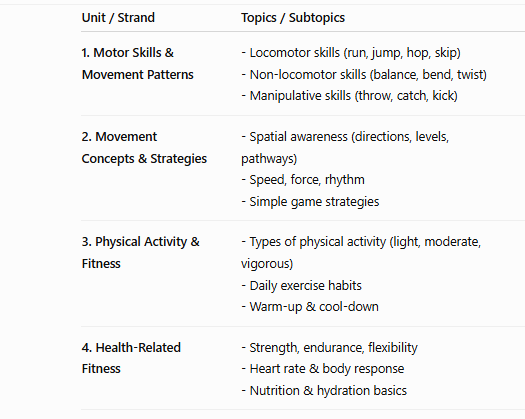
| 1. Motor Skills & Movement Patterns | – Locomotor skills (run, jump, hop, skip) – Non-locomotor skills (balance, bend, twist) – Manipulative skills (throw, catch, kick) |
– Demonstrate basic movement patterns with control and coordination – Perform simple motor skills in activities and games – Show balance and body control |
| 2. Movement Concepts & Strategies | – Spatial awareness (directions, levels, pathways) – Speed, force, rhythm – Simple game strategies |
– Understand movement concepts like direction and speed – Apply basic strategies in games and activities – Recognize safe movement in shared space |
| 3. Physical Activity & Fitness | – Types of physical activity (light, moderate, vigorous) – Daily exercise habits – Warm-up & cool-down |
– Participate regularly in physical activities – Identify benefits of exercise and active lifestyle – Differentiate activity intensity levels |
| 4. Health-Related Fitness | – Strength, endurance, flexibility – Heart rate & body response – Nutrition & hydration basics |
– Recognize how physical activity improves health – Identify basic fitness components – Understand importance of hydration and nutrition |
| 5. Social & Emotional Skills | – Teamwork and cooperation – Respect and sportsmanship – Following rules |
– Work cooperatively with peers – Show respect for others’ abilities – Follow rules and demonstrate fair play |
| 6. Safety & Responsible Behavior | – Personal and equipment safety – Safe use of space – Injury prevention |
– Demonstrate safe practices during activities – Use equipment properly – Understand importance of safety rules |
| 7. Value of Physical Activity | – Enjoyment and self-expression – Benefits of active lifestyle – Participation in games, dance, sports |
– Recognize the importance of physical activity for health and fun – Develop positive attitude toward exercise – Engage in activities for enjoyment and social interaction |
Detailed Syllabus for Grade 2 Physical Education
1. Fundamental Movement Skills
Students learn and practice essential movement patterns such as:
- Running, hopping, skipping, galloping
- Jumping and landing techniques
- Balancing and body control
- Spatial awareness and direction control
These skills form the base for all future sports and activities.
2. Locomotor and Non-Locomotor Skills
- Locomotor skills: walking, running, leaping, sliding
- Non-locomotor skills: bending, twisting, stretching, balancing
Students also learn to combine movements smoothly and efficiently.
3. Manipulative Skills
Activities involving objects help improve coordination:
- Throwing and catching
- Kicking and striking
- Dribbling and rolling
- Use of equipment like balls, hoops, and ropes
These skills are important for participation in games and sports.
4. Fitness and Physical Health
Students are introduced to basic fitness concepts, including:
- Strength, endurance, and flexibility
- Warm-up and cool-down exercises
- Understanding heart rate and breathing
- Importance of regular physical activity
They begin to understand how exercise affects their body.
5. Movement Concepts and Strategies
Students learn how to apply:
- Space, speed, and force
- Direction and pathways
- Simple game strategies (attack, defense, positioning)
This helps improve game performance and decision-making skills.
6. Teamwork and Social Skills
A key focus area includes:
- Cooperation and communication
- Respect for others
- Following rules and fair play
- Conflict resolution
- Leadership and participation
Students learn how to work effectively in groups and teams.
7. Safety and Personal Responsibility
Students are taught:
- Safe use of equipment
- Awareness of personal and general space
- Injury prevention techniques
- Importance of rules and discipline
Safety is a critical component of all PE activities.
8. Rhythm, Dance, and Creative Movement
- Simple rhythmic activities
- Cultural and creative dance movements
- Expression through body movement
This enhances creativity and coordination.
Units Covered in Grade 2 PE
Typical units included in the syllabus are:
| Unit | Description |
|---|---|
| Physical Fitness | Exercises for strength, flexibility, and endurance |
| Movement Skills | Locomotor and non-locomotor activities |
| Manipulative Skills | Ball handling, throwing, catching |
| Games & Activities | Tag games, chasing, small team games |
| Teamwork Activities | Cooperative games and problem-solving tasks |
| Rhythm & Dance | Basic dance and movement expression |
Teaching Methodology
The US Grade 2 PE curriculum uses activity-based and student-centered learning:
- Play-based learning
- Group activities and games
- Demonstration and practice
- Inclusive and adaptive activities
- Use of equipment and real-life scenarios
The emphasis is on learning by doing rather than theory.
Assessment Methods
Assessment in Grade 2 PE is continuous and performance-based:
- Teacher observation
- Skill demonstration
- Participation and effort
- Fitness activities
- Student self-reflection
There are no high-pressure exams; focus is on progress and participation.
Curriculum Standards and Learning Outcomes
The Grade 2 PE syllabus is structured around the five SHAPE America National Standards. The following learning outcomes are aligned with these standards for the 2026-27 school year.
Standard 1: Motor Skills and Movement Patterns
The physically literate individual demonstrates competency in a variety of motor skills and movement patterns.
Second graders will develop their motor skills across three main categories:
1. Locomotor Skills (Moving from place to place):
-
Skips using a mature pattern.
-
Runs with a mature pattern and shows differentiation between jogging and sprinting.
-
Demonstrates critical elements for jumping and landing in both horizontal and vertical planes, using a variety of one- and two-foot takeoffs and landings.
-
Performs a teacher- or student-designed rhythmic activity with correct response to simple rhythms .
2. Non-Locomotor Skills (Stability and Balance):
-
Balances on different bases of support, combining levels and shapes.
-
Balances in an inverted position with stillness and a supportive base.
-
Transfers weight from feet to different body parts for balance and travel.
-
Rolls in different directions with either a narrow or curled body shape.
-
Differentiates among twisting, curling, bending, and stretching actions.
-
Combines balances and transfers into a three-part movement sequence (e.g., dance or gymnastics) .
3. Manipulative Skills (Handling objects):
-
Throws underhand using a mature pattern and throws overhand, demonstrating 2 of the 5 critical elements.
-
Catches a self-tossed or well-thrown large ball with hands, not trapping it against the body.
-
Dribbles in self-space and while walking in general space using the preferred hand. Also dribbles with the feet in general space with control.
-
Uses a continuous running approach and kicks a moving ball, demonstrating 3 of the 5 critical elements.
-
Volleys an object upward with consecutive hits.
-
Strikes an object upward with a short-handled implement using consecutive hits, and strikes a ball off a tee or cone with a bat using correct grip and body orientation.
-
Jumps a self-turned rope forward and backward with a mature pattern, and jumps a long rope up to five times consecutively with student turners .
Standard 2: Movement Concepts and Knowledge
The physically literate individual applies knowledge of concepts, principles, strategies, and tactics related to movement and performance.
Second graders will learn to apply the following concepts to their movement:
-
Combines locomotor skills in general space to a rhythm.
-
Combines shapes, levels, and pathways into simple travel, dance, and gymnastics sequences.
-
Varies time and force with gradual increases and decreases .
Standard 3: Physical Activity and Fitness
The physically literate individual demonstrates the knowledge and skills to achieve and maintain a health-enhancing level of physical activity and fitness.
Students will understand and apply fitness concepts:
-
Actively engages in physical education class.
-
Describes large-motor and manipulative physical activities for participation outside of PE class.
-
Uses own body as resistance (e.g., holds body in plank position, animal walks) for developing strength.
-
Recognizes the “good health balance” of nutrition and physical activity.
-
Identifies the heart as a muscle that gets stronger with exercise .
Standard 4: Personal and Social Behavior
The physically literate individual exhibits responsible personal and social behavior that respects self and others.
The social-emotional aspect of PE is critical in second grade. Students will:
-
Practice skills with minimal teacher prompting.
-
Accept responsibility for class protocols with behavior and performance actions.
-
Accept specific corrective feedback from the teacher.
-
Work independently with others in partner environments.
-
Exhibit the use of rules and etiquette in teacher-designed physical activities.
-
Work independently and safely in physical education .
Standard 5: Value of Physical Activity
The physically literate individual recognizes the value of physical activity for health, enjoyment, challenge, self-expression, and/or social interaction.
Students will learn to appreciate physical activity by:
-
Identifying physical activities that bring confidence and challenge.
-
Identifying physical activities that provide self-expression (e.g., dance, gymnastics routines) .
Sample Lesson and Integrated Activities
The PE curriculum often uses creative and integrated activities to make learning more engaging. For example, a second-grade unit on striking with hands might incorporate spelling words into a “Striking Spelling Bee” activity .
In this activity, students work with a partner to spell out words on their spelling list by striking a balloon or soft ball with an underhand motion to hit letter targets taped to the wall. This activity not only teaches the critical elements of underhand striking—such as facing the target and following through—but also reinforces literacy skills and promotes teamwork and cooperation .
Assessment
Assessment in Grade 2 PE is developmentally appropriate and focuses on observation and self-reflection rather than formal grades or fitness testing, which is not recommended at this age . Teachers use a variety of methods to gauge student progress, including:
-
Teacher Observation: A primary tool for assessing both psychomotor skills and affective behaviors like cooperation and effort.
-
Class Discussion and Student Reflection: Used to check for understanding of concepts and to gauge student enjoyment and attitudes.
-
Self-Assessment: Students may use simple rating scales (e.g., “WOW!”, “Got it!”, “Getting there!”) to reflect on their own performance .
-
Simple Skill Tests: For example, a juggling test or a “Heart Smart” challenge .
Conclusion
The US Grade 2 Physical Education syllabus for 2026-27 provides a comprehensive and engaging framework for developing physically literate students. By focusing on a wide range of motor skills, fitness concepts, and positive social behaviors, the curriculum aims to instill a lifelong appreciation for physical activity, health, and teamwork. The syllabus ensures that all students can succeed and find joy in movement, setting a strong foundation for their future health and well-being.
About The Author
