
N. Chandrasekaran, Executive Chairman of Tata Sons (the holding company of the Tata Group), received a total remuneration of approximately ₹158.66 crore for the financial year ended 31 March 2026 (FY26). This marks his highest annual compensation since Tata Sons began disclosing directors’ pay in detail around FY22. The package reflects a modest overall increase from ₹155.81 crore in FY25, driven mainly by a rise in the fixed component while the large profit-linked commission stayed flat.
His cumulative earnings over the five years through FY26 stand in the range of roughly ₹671–685 crore according to different compilations of the company’s annual reports. The FY26 payout accounted for nearly 80% of the total remuneration paid to all Tata Sons directors that year. Chandrasekaran ranks among India’s highest-paid corporate leaders, though his package remained below the remuneration reported for HCLTech CEO C. Vijayakumar in the same period.
N. Chandrasekaran’s Role and Compensation Structure
N. Chandrasekaran has served as Executive Chairman of Tata Sons since February 2017 (after joining the board in 2016) and previously led Tata Consultancy Services as CEO and MD. His compensation is heavily performance-oriented. The bulk comes from a profit-linked commission rather than fixed salary. This structure aligns the chairman’s rewards with the overall profitability and performance of the Tata Group’s holding company. Fixed pay (salary and other benefits) has risen steadily over the years, while commission has grown in tandem with company results before stabilising at a high level. The Nomination and Remuneration Committee and the board oversee these arrangements, with disclosures made in the annual report. Note that as of mid-August 2026, reports indicated he would not seek re-appointment beyond his tenure ending in February 2027.
TATA Sons Chairman Salary and Remuneration for FY26
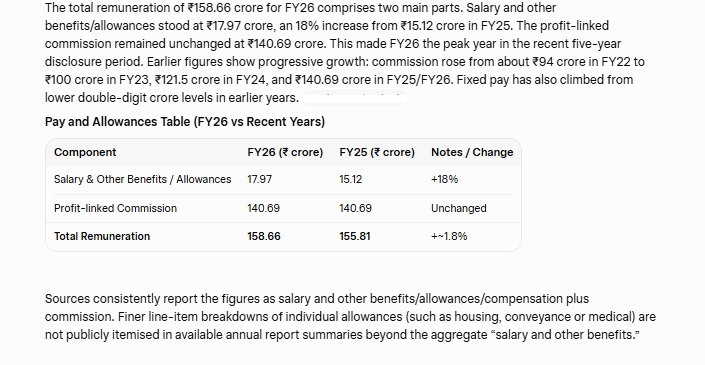
The total remuneration of ₹158.66 crore for FY26 comprises two main parts. Salary and other benefits/allowances stood at ₹17.97 crore, an 18% increase from ₹15.12 crore in FY25. The profit-linked commission remained unchanged at ₹140.69 crore. This made FY26 the peak year in the recent five-year disclosure period. Earlier figures show progressive growth: commission rose from about ₹94 crore in FY22 to ₹100 crore in FY23, ₹121.5 crore in FY24, and ₹140.69 crore in FY25/FY26. Fixed pay has also climbed from lower double-digit crore levels in earlier years.
Pay and Allowances Table (FY26 vs Recent Years)
| Component | FY26 (₹ crore) | FY25 (₹ crore) | Notes / Change |
|---|---|---|---|
| Salary & Other Benefits / Allowances | 17.97 | 15.12 | +18% |
| Profit-linked Commission | 140.69 | 140.69 | Unchanged |
| Total Remuneration | 158.66 | 155.81 | +~1.8% |
Sources consistently report the figures as salary and other benefits/allowances/compensation plus commission. Finer line-item breakdowns of individual allowances (such as housing, conveyance or medical) are not publicly itemised in available annual report summaries beyond the aggregate “salary and other benefits.”
TATA Sons Chairman Year-wise Trend in Compensation
Chandrasekaran’s pay has shown consistent upward movement over the disclosure period. Fixed components rose gradually while commission tracked group profitability. Cumulative five-year earnings reached approximately ₹671–685 crore. His share of total director remuneration at Tata Sons has remained dominant (around 80% in FY26). Second-highest earner among directors in FY26 was Executive Director and CFO Saurabh Agrawal (around ₹34 crore, including significant commission). Most other directors received only sitting fees or limited amounts.
Historical Commission Trend (Approximate)
| Financial Year | Commission (₹ crore) | Salary & Benefits (₹ crore, approx.) |
|---|---|---|
| FY22 | 94 | ~14.6 |
| FY23 | 100 | ~13 |
| FY24 | 121.5 | ~13.8 |
| FY25 | 140.69 | 15.12 |
| FY26 | 140.69 | 17.97 |
Benefits and Other Components of the Package
The “salary and other benefits” or “salary and allowances” component of ₹17.97 crore in FY26 covers fixed pay plus associated perquisites and benefits as per the company’s remuneration policy. Detailed public disclosures typically aggregate these rather than listing every perquisite separately. Common elements in such senior executive packages at large Indian conglomerates include contributions toward retirement benefits, medical coverage, and other standard allowances, though exact allocations for Chandrasekaran are not broken out further in the cited reports. The dominant element remains the variable commission, which is explicitly profit-linked and forms the overwhelming majority of total pay. This performance orientation is a deliberate design of the compensation structure at Tata Sons.
Comparison with Other Top Indian Executives
Chandrasekaran’s FY26 package places him firmly among the highest-paid corporate leaders in India. It trails the higher figure reported for HCLTech’s C. Vijayakumar (around ₹176 crore) but exceeds many other prominent CEOs and chairpersons in the same period. Within the Tata Group, his remuneration significantly exceeds that of other directors and most listed-group CEOs. The structure—modest fixed pay relative to total package plus large variable commission—mirrors practices at other high-performing Indian companies where variable pay dominates for top leadership.
Context and Governance Notes
Tata Sons discloses director remuneration in its annual report and corporate governance section. Chandrasekaran’s current term as Executive Chairman was set to run until February 2027, with re-appointment as director subject to shareholder approval (he is liable to retire by rotation). The large commission component underscores the link between leadership rewards and company performance. Aggregate Tata Group revenue and profits showed growth in the relevant periods, providing the backdrop for the sustained high commission levels. Readers should refer to the official Tata Sons annual report for the most authoritative figures, as secondary reports occasionally round the totals slightly differently (₹158.6 vs ₹158.66 crore).
In summary, the Tata Sons Chairman’s FY26 remuneration of ₹158.66 crore—₹17.97 crore in salary and benefits plus ₹140.69 crore commission—represents the highest disclosed annual package in the recent five-year window and reflects a strongly performance-linked approach. The fixed portion saw a healthy increase while the variable portion held steady at a record level.
About The Author
