
The Union Public Service Commission (UPSC) conducted the Combined Medical Services (CMS) Examination 2026 on August 2, 2026. This national-level exam recruits Medical Officers for posts under the Central Health Service and other organizations such as the Indian Railways, New Delhi Municipal Council, and Municipal Corporation of Delhi. Thousands of MBBS graduates appear every year, making the competition intense. The cutoff marks play a decisive role in shortlisting candidates for the Personality Test and in determining the final merit list. Official cutoffs will be released by UPSC only after the final results, but expected category-wise marks based on exam analysis, previous trends, vacancy numbers, and difficulty level provide a useful benchmark for candidates.
Understanding the cutoff helps aspirants evaluate their performance and plan the next steps. The written exam carries 500 marks, while the Personality Test adds another 100 marks, making the total 600. Separate cutoffs are prepared for Category I (Central Health Service) and Category II (Non-CHS posts). This article covers the expected cutoffs, previous year trends, factors that influence the marks, the selection process, and practical tips for candidates awaiting results.
What is UPSC CMS Cutoff?
The UPSC CMS cutoff refers to the minimum marks a candidate must secure to qualify for the next stage of the selection process or to be recommended for appointment. For the written examination, the cutoff is calculated out of 500 marks. After the Personality Test, a final cutoff is determined out of 600 marks. These thresholds are not fixed in advance; they are decided by the Commission after evaluating the overall performance of candidates. The cutoff varies across categories such as General, EWS, OBC, SC, ST, and Persons with Benchmark Disabilities (PwBD). Separate lists are prepared for Category I and Category II posts because the number of vacancies and the nature of the posts differ. Candidates scoring equal to or above the cutoff are considered for further stages. The official cutoff is published on the UPSC website only after the final results are declared, usually in a PDF containing category-wise and stage-wise details. Until then, expected cutoffs based on expert analysis and past patterns serve as a reliable guide for aspirants.
UPSC CMS Expected Cutoff Marks 2026
Since the written examination was held on August 2, 2026, candidates are keenly waiting for an idea of the expected cutoff. Based on preliminary exam analysis, the number of vacancies (around 1,358–1,359), and recent trends, the expected written cutoff out of 500 marks is projected in specific ranges. For Category I posts, the General category is expected to require 270–280 marks, while EWS may need 245–255, OBC 265–275, SC 230–240, and ST 200–210. The corresponding final cutoff (written + interview) out of 600 is anticipated around 350–360 for General, 325–335 for EWS, 310–320 for OBC, 290–300 for SC, and 280–290 for ST. For Category II posts, the written cutoff ranges remain similar, but the final cutoff is slightly lower: approximately 345–355 for General, 315–325 for EWS, 300–310 for OBC, 300–310 for SC, and 270–280 for ST. These figures are estimates drawn from post-exam reviews and historical data. Actual cutoffs can shift depending on the exact difficulty level of the papers and the distribution of scores. Candidates who scored close to or above these ranges stand a strong chance of being called for the Personality Test.
UPSC CMS Expected Cutoff 2026 (Category-wise)
Category-wise cutoffs ensure fairness by accounting for reservation policies. In Category I, which covers Medical Officers in the Central Health Service, the competition is often tighter due to the prestige and nature of the posts. General candidates typically need the highest scores, followed closely by OBC, then EWS, SC, and ST. PwBD candidates have significantly lower qualifying marks to promote inclusivity. In Category II, covering posts in Railways and municipal bodies, the final cutoffs tend to be a few marks lower because of a larger number of vacancies. The expected ranges remain consistent across both categories for the written stage, reflecting the common examination. Candidates belonging to reserved categories should note that they can also be considered against unreserved vacancies if their scores meet the General standard. These expected figures help candidates from every category assess their relative standing. It is important to remember that the final official numbers may vary slightly once UPSC processes all answer scripts and applies its internal standardization methods.
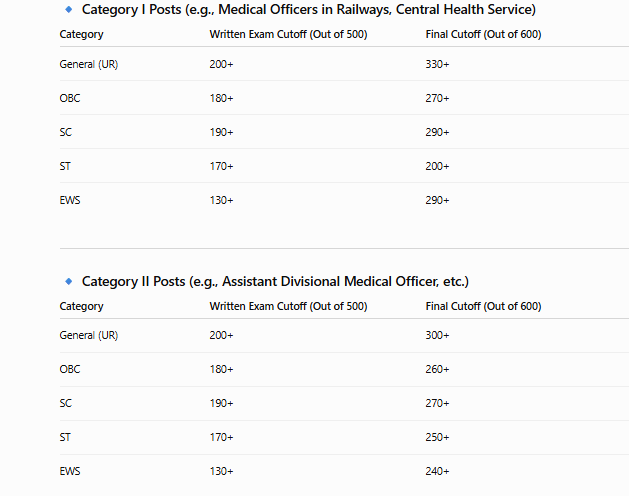
Category I Posts (e.g., Medical Officers in Railways, Central Health Service)
| Category | Written Exam Cutoff (Out of 500) | Final Cutoff (Out of 600) |
|---|---|---|
| General (UR) | 200+ | 330+ |
| OBC | 180+ | 270+ |
| SC | 190+ | 290+ |
| ST | 170+ | 200+ |
| EWS | 130+ | 290+ |
Category II Posts (e.g., Assistant Divisional Medical Officer, etc.)
| Category | Written Exam Cutoff (Out of 500) | Final Cutoff (Out of 600) |
|---|---|---|
| General (UR) | 200+ | 300+ |
| OBC | 180+ | 260+ |
| SC | 190+ | 270+ |
| ST | 170+ | 250+ |
| EWS | 130+ | 240+ |
Important Points
- The CMS exam consists of:
- Written Exam (500 marks)
- Interview/Personality Test (100 marks)
- Minimum qualifying marks:
- 30% for General/OBC/SC/ST
- 20% for PwBD candidates
- Cutoff depends on:
- Difficulty level of paper
- Number of vacancies
- Overall candidate performance
Previous Year Trend (Reference)
- 2025 General Final Cutoff: ~380 marks
- 2024 General Final Cutoff: ~403 marks
This shows that the cutoff fluctuates significantly, so aiming for 350+ (safe score) is recommended for the General category.
Safe Score for 2026
| Category | Safe Score (Final) |
|---|---|
| General | 350–380 |
| OBC | 320–350 |
| SC | 300–330 |
| ST | 280–310 |
Factors Affecting UPSC CMS Cutoff 2026
Several key factors determine the final cutoff marks each year. The total number of vacancies is one of the strongest influences; higher vacancies generally lead to a lower cutoff, while fewer seats push the threshold upward. In 2026, approximately 1,358–1,359 posts were notified, which is relatively high and may exert downward pressure on the cutoff compared with years that had fewer openings. The difficulty level of the two papers also plays a major role. If Paper I (General Medicine and Paediatrics) or Paper II (Surgery, Gynaecology & Obstetrics, and Preventive & Social Medicine) turns out tougher than usual, average scores drop and the cutoff declines. The overall performance of candidates, including the number of high scorers, further shapes the merit list. Reservation norms and the distribution of candidates across categories affect category-specific cutoffs. Negative marking of one-third mark for every wrong answer encourages careful attempts and can compress the score range. Finally, the quality of the answer key and any representations submitted by candidates may lead to minor adjustments before the official cutoff is finalized. All these elements together create the year-specific threshold that candidates must meet.
Previous Year UPSC CMS Cutoff Trends
Examining previous year cutoffs provides valuable context for the 2026 expectations. In the 2025 cycle, the written cutoff out of 500 was 290.24 for General, 278.20 for OBC, 243.30 for SC, 222.49 for ST, and 251.18 for EWS across both categories. The final cutoff out of 600 stood at 380.20 (Category I) and 368.45 (Category II) for General candidates. In 2024, the written cutoff was higher at 309 for General, with final marks reaching 403 for Category I and 386 for Category II. Earlier years showed greater variation: 2023 recorded a General written cutoff of around 240 and a final of 332–322 depending on the category. These fluctuations illustrate how vacancy numbers and paper difficulty can swing the cutoff by 20–50 marks or more. Over the last few cycles, the General written cutoff has mostly stayed in the 240–310 range, while reserved categories have followed a proportional pattern. Candidates targeting 2026 should therefore aim comfortably above the expected ranges to remain competitive even if the actual cutoff rises. Historical data also shows that strong performance in the Personality Test can help candidates who are just above the written cutoff secure a final recommendation.
How to Check Official UPSC CMS Cutoff 2026
Once UPSC releases the official cutoff, candidates can download it easily from the Commission’s website. Visit the official portal at upsc.gov.in and navigate to the “Examinations” or “Cutoff Marks” section. Look for the link related to the Combined Medical Services Examination 2026. The cutoff is usually published as a PDF document that lists minimum qualifying standards for the written result and the final result, separately for Category I and Category II, and for every category including PwBD. Candidates should cross-check the marks against their own scorecard, which is also released on the same website. It is advisable to download and save the PDF for future reference, as the information remains relevant for subsequent recruitment cycles and for understanding selection trends. Regularly monitoring the UPSC website and authentic news sources ensures that candidates do not miss the release date. The official cutoff supersedes all expected figures and becomes the definitive benchmark for qualification and recommendation.
UPSC CMS Selection Process Overview
The selection process for UPSC CMS consists of two main stages. The first stage is the written examination comprising two objective papers of 250 marks each, totaling 500 marks. Paper I covers General Medicine (96 questions) and Paediatrics (24 questions), while Paper II includes Surgery, Gynaecology & Obstetrics, and Preventive & Social Medicine (40 questions each). Both papers are of two hours’ duration and carry negative marking of one-third mark for incorrect answers. Candidates who secure marks equal to or above the written cutoff are shortlisted for the second stage—the Personality Test or Interview, which carries 100 marks. The interview assesses general knowledge, academic depth, intellectual curiosity, integrity, and leadership qualities. Final merit lists are prepared separately for Category I and Category II on the basis of aggregate marks out of 600. Document verification follows the interview, after which successful candidates receive appointment offers according to their rank and preferences. Understanding this process helps candidates focus their efforts at each stage and interpret cutoff marks correctly.
Tips for Candidates Awaiting UPSC CMS 2026 Results
Candidates who have appeared in the examination should first calculate their approximate scores using reliable answer keys released by coaching institutes and subject experts. Compare the estimated score with the expected cutoff ranges given above to gauge the likelihood of qualification. Those who fall comfortably above the expected marks can begin preparing for the Personality Test by revising medical ethics, current health policies, and common interview topics. Candidates near the borderline should stay updated with official notifications and avoid relying solely on unofficial predictions. It is also useful to keep all educational and category certificates ready for the document verification stage. Regularly check the UPSC website for result and cutoff announcements. Maintaining a balanced approach—neither becoming overconfident nor overly anxious—helps candidates handle the waiting period productively. Finally, analyzing performance in the written papers can provide insights for future attempts or for improving interview readiness.
The UPSC CMS Cutoff 2026 will ultimately decide who progresses to the Personality Test and who secures a final recommendation. While the expected category-wise marks offered in this article serve as a practical guide, the official figures released by the Commission will be the only authoritative reference. Candidates are encouraged to stay patient, keep monitoring the official website, and use the intervening time to strengthen their interview skills. Success in this highly competitive examination depends on consistent preparation, accurate self-assessment, and timely action at every stage of the process.
About The Author
