
The Bihar Public Service Commission (BPSC) Syllabus 2026 is designed to evaluate candidates for administrative roles in Bihar through a structured three-stage process: Prelims, Mains, and Interview. The syllabus broadly covers subjects like General Studies, History, Geography, Polity, Economy, Science, and Current Affairs. The Prelims exam is objective, while the Mains includes descriptive papers focusing on analytical and writing skills. It emphasizes Bihar-specific knowledge along with national and international topics. Overall, the syllabus aims to assess a candidate’s intellectual ability, awareness, and suitability for civil services.
Overview of BPSC Examination
The Bihar Public Service Commission (BPSC) is one of the most sought-after examinations in India, attracting thousands of aspirants every year. A thorough understanding of the BPSC syllabus is crucial for effective preparation. This article provides a detailed breakdown of the syllabus for all stages of the examination: Preliminary, Mains, and Optional Subjects.
| Particulars | Details |
| Conducting Body | Bihar Public Service Commission (BPSC) |
| Examination | Combined Competitive Examination (CCE) |
| Selection Stages | Preliminary Examination, Main Examination, Personality Test |
| Preliminary Paper | General Studies |
| Prelims Marks | 150 |
| Prelims Duration | 2 Hours |
| Main Examination Papers | General Hindi, General Studies Paper I, General Studies Paper II, One Optional Subject |
| Marks for General Hindi | 100 (Qualifying) |
| Marks for General Studies Paper I | 300 |
| Marks for General Studies Paper II | 300 |
| Marks for Optional Subject | 300 |
| Personality Test | 120 Marks |
| Language of Question Papers | Hindi and English |
Stages of the Examination
The BPSC Civil Services Exam is conducted in three stages:
- Preliminary Examination: Objective type questions with a single General Studies paper.
- Mains Examination: Descriptive in nature, including compulsory and optional papers.
- Interview: A personality test to evaluate a candidate’s suitability for administrative roles.
Weightage of Each Stage
- Preliminary Exam: Qualifying in nature; scores are not counted for the final merit list.
- Mains Exam: Holds the highest weightage in the selection process.
- Interview: Adds significant value to the final score.
The BPSC exam has three stages: Preliminary (150 marks, qualifying only), Main (900 marks: General Hindi qualifying + two General Studies papers + one optional subject), and Interview (120 marks). The detailed exam pattern is given below :
BPSC Exam Pattern 2026
BPSC Prelims Exam Pattern
The written examination will be conducted in an objective (MCQ) format. The paper will consist of 150 questions carrying a total of 150 marks, and candidates will be given 2 hours to complete the test.
- Negative Marking- 1/3
| Papers | Total Questions | Total Marks | Time Duration |
| General Studies | 150 | 150 marks | 2 hours |
BPSC Mains Exam Pattern 2026
The BPSC Mains Exam includes a qualifying paper in General Hindi. Along with the , there are two general studies papers- Paper I and Paper II
- MarksTotal of 900 marks(which will be added to the interview marks).
- Structure:Consists of Compulsory Subjects and One Optional Subject
Compulsory Subjects (Main Exam)
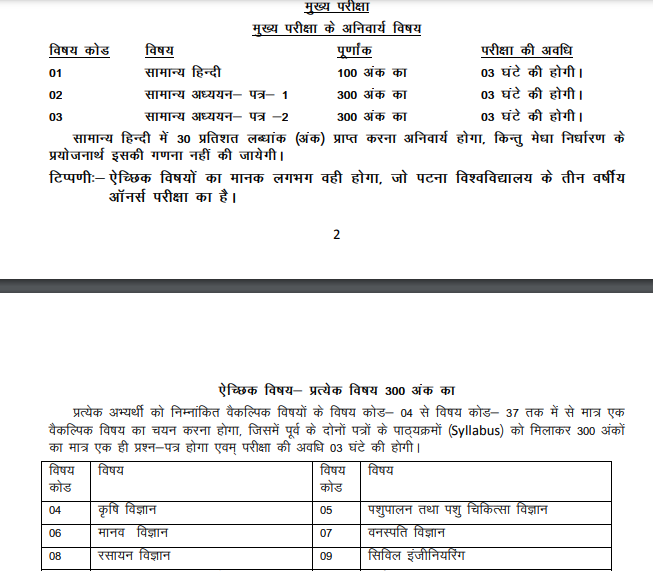
| Subject Code | Subject Name | Total Marks | Duration |
|---|---|---|---|
| 01 | General Hindi | 100 | 3 hours |
| 02 | General Studies Paper-1 | 300 | 3 hours |
| 03 | General Studies Paper-2 | 300 | 3 hours |
A candidate must secure at least 30% marks in the General Hindi paper. However, these marks are not counted in the aggregation for the final merit list. It is a qualifying paper.
Optional Subject (Main Exam)
A candidate must choose only one optional subject from the list of subjects provided (Subject Code 04 to 37). Each optional subject will have a single question paper carrying 300 marks, which includes the combined syllabus of two conventional papers. The duration of the optional paper will be 3 hours.
List of Optional Subjects (Codes 04-37):
| Code | Subject Name | Code | Subject Name |
|---|---|---|---|
| 04 | Agriculture Science | 21 | Philosophy |
| 05 | Animal Husbandry & Veterinary Science | 22 | Physics |
| 06 | Anthropology | 23 | Political Science & International Relations |
| 07 | Botany | 24 | Psychology |
| 08 | Chemistry | 25 | Public Administration |
| 09 | Civil Engineering | 26 | Sociology |
| 10 | Commerce & Accountancy | 27 | Statistics |
| 11 | Economics | 28 | Zoology |
| 12 | Electrical Engineering | 29 | Hindi Language & Literature |
| 13 | Geography | 30 | English Language & Literature |
| 14 | Geology | 31 | Urdu Language & Literature |
| 15 | History | 32 | Bengali Language & Literature |
| 16 | Labour & Social Welfare | 33 | Sanskrit Language & Literature |
| 17 | Law | 34 | Persian Language & Literature |
| 18 | Management | 35 | Arabic Language & Literature |
| 19 | Mathematics | 36 | Pali Language & Literature |
| 20 | Mechanical Engineering | 37 | Maithili Language & Literature |
Personality Test (Interview)
- Marks:120 marks.
- Purpose:To assess the candidate’s personal qualities, intellectual traits, and interest in matters beyond their academic curriculum.
- Final Merit List: Based on the aggregate of Main Exam (900 marks) + Interview (120 marks) = Total 1020 marks.
BPSC Preliminary Examination Syllabus
General Studies (GS)
The Preliminary exam consists of one General Studies paper. Key topics include:
- Current Affairs: National and international events, sports, awards, and government schemes.
- Indian History and National Movement: Focus on ancient, medieval, and modern history.
- Geography: Physical, social, and economic geography of India and Bihar.
- Indian Polity and Economy: Constitution, political system, Panchayati Raj, and economic development.
- General Science: Basic concepts from Physics, Chemistry, and Biology.
BPSC PT Syllabus 2026
The latest BPSC Prelims (PT) Syllabus 2026 in a simple, exam-oriented format:
BPSC PT (Prelims) Syllabus
Exam Pattern
- Paper: General Studies (GS)
- Questions: 150 MCQs
- Marks: 150
- Time: 2 Hours
- Negative Marking: 1/3 mark deduction
Bihar BPSC PT Syllabus 2026 in details
General Science
- Physics, Chemistry, Biology (Class 6–10 level)
- Everyday science & applications
- Environment & basic science concepts
Current Affairs
- National & International events
- Government schemes
- Awards, sports, summits
- Important news (last 6–12 months)
History (India + Bihar)
- Ancient, Medieval, Modern India
- Indian Freedom Struggle
- Bihar’s role in independence
- Important personalities & events
Geography (India + Bihar)
- Physical geography (rivers, mountains, climate)
- Indian agriculture & resources
- Bihar geography (rivers, soil, irrigation)
Indian Polity
- Constitution of India
- Fundamental Rights & Duties
- Panchayati Raj
- Governance system (India + Bihar)
Economy
- Indian Economy basics
- Planning & budgeting
- Agriculture & industry
- Bihar economy & development
General Mental Ability
- Logical reasoning
- Analytical ability
- Basic data interpretation
Important Points
- Prelims is qualifying only (marks not counted in final merit)
- Strong focus on Bihar-specific GK + Current Affairs
- Level is mostly NCERT-based (6–10)
Preparation Tip (Important)
Focus more on:
- Current Affairs
- History + Bihar GK
- General Science (easy scoring)
BPSC Mains Syllabus 2026
The Main Examination consists of compulsory papers and one optional subject selected by the candidate. The compulsory papers are:
| Subject | Marks | Duration |
| General Hindi | 100 | 3 Hours |
| General Studies Paper I | 300 | 3 Hours |
| General Studies Paper II | 300 | 3 Hours |
The General Hindi paper is qualifying in nature. Candidates must obtain 30% marks in this paper. However, these marks are not counted while preparing the merit list.
General Hindi Syllabus
The General Hindi paper is qualifying in nature and is designed to assess a candidate’s ability to write simple and clear Hindi. Candidates must score at least 30% to qualify. However, these marks are not included in the final merit list. The mark distribution is:
-
Essay: 30 marks
-
Grammar: 30 marks
-
Sentence structure: 25 marks
-
Précis writing: 15 marks
General Studies Paper I Syllabus
This paper covers modern Indian history, Indian culture, and current events. It also has a section on statistical analysis and diagrams. The exact topics are:
Modern History of India and Indian Culture
General Studies Paper I focuses on modern Indian history, Indian culture, current affairs, and data interpretation. Candidates are expected to understand historical developments, cultural heritage, and to analyse statistical information presented through graphs and charts.
Current Events of National and International Importance
Questions may be asked on important national and international developments. Candidates should remain aware of significant events and their relevance.
Statistical Analysis, Graphs and Diagrams
This section tests the ability to understand statistical information presented through graphs, charts, and diagrams.
Candidates should be able to analyse the given information and draw logical conclusions based on the available data.
General Studies Paper II Syllabus
General Studies Paper II evaluates a candidate’s understanding of the Indian Constitution, governance, economy, geography, and science & technology. Questions may also include Bihar-specific topics wherever applicable.
Indian Polity
This section covers the political system of India with reference to constitutional and administrative aspects. Questions are asked to assess the candidate’s understanding of the Indian political framework. The syllabus also includes topics related to Bihar wherever applicable.
Indian Economy and Geography of India
The syllabus includes the Indian economy along with the geography of India and Bihar. Candidates should prepare topics related to economic planning, physical geography, economic geography, and social geography. Questions may also be asked on the important geographical features of Bihar.
Role and Impact of Science and Technology in the Development of India
This section evaluates the candidate’s understanding of science and technology and their contribution to India’s development. Candidates should also understand the importance and practical applications of science and technology in Bihar.
BPSC Optional Subjects List
The BPSC Main Examination allows candidates to choose one optional subject carrying 300 marks. The Commission provides a list of optional subjects, each with a detailed syllabus divided into sections.
BPSC Agriculture Syllabus
Section 1 focuses on ecology, crop production factors, Bihar’s agro-climatic zones, cropping patterns, soil formation and classification, soil conservation, irrigation, farm management, and agricultural marketing. Section 2 covers plant breeding, genetics, seed technology, plant physiology, fruit and vegetable production, plant diseases and pest control, and food production trends in Bihar and India.
BPSC Animal Husbandry and Veterinary Science Syllabus
Section 1 covers animal nutrition, animal physiology, livestock production and management, dairy farming, and milk technology. Section 2 covers genetics and animal breeding, animal health and hygiene, milk product technology, meat hygiene, and extension education for farmers.
BPSC Anthropology Syllabus
This subject has three sections. Section 1 covers the meaning and branches of anthropology, marriage, kinship, economic and political anthropology, and the study of Indian tribes such as Oraon, Munda, Ho, Santhal, and Birhor. Section 2 offers a choice between physical anthropology topics like human evolution and fossil evidence, or theory-based topics like diffusionism and structuralism. Section 3 covers Indian anthropology, including the Indus civilization, caste, tribal problems, and tribal movements like the Tana Bhagat and Birsa movements.
BPSC Botany Syllabus
Section 1 covers microbiology, plant pathology, cryptogams, phanerogams, and plant morphogenesis. Section 2 covers cell biology, genetics and evolution, plant physiology and biochemistry, ecology, and economic botany.
BPSC Chemistry Syllabus
Section 1 covers atomic structure and chemical bonding, thermodynamics, solid state chemistry, chemical kinetics, electrochemistry, photochemistry, and the chemistry of d-block and f-block elements. Section 2 covers reaction mechanisms, pericyclic reactions, named organic reactions, polymer systems, and spectroscopy methods used in structure determination.
BPSC Civil Engineering Syllabus
Section 1 covers the theory and design of structures, structural steel, reinforced concrete, fluid mechanics, soil mechanics, foundation engineering, and computer programming basics. Section 2 lets candidates choose two out of four parts: building construction, transportation engineering, water resources and irrigation engineering, and environmental engineering.
BPSC Commerce and Accountancy Syllabus
Section 1 covers accounting, auditing, taxation, business finance, and financial institutions such as the Reserve Bank of India and the Indian capital market. Section 2 covers organisation theory and industrial relations, including trade unions and collective bargaining in India.
BPSC Economics Syllabus
Section 1 covers the structure of the economy, consumer and producer behaviour, income and employment determination, banking, taxation, and international trade. Section 2 covers the Indian economy, agricultural and industrial production, Indian planning, and the Bihar economy, including poverty and unemployment in Bihar.
BPSC Electrical Engineering Syllabus
Section 1 covers network theory, electrostatics and magnetics, measurement methods, electronics, and electrical machines. Section 2 offers control systems and industrial electronics as compulsory topics, with a choice between heavy current topics like power systems and protection, or light current topics like communication systems and microwaves.
BPSC Geography Syllabus
Section 1 covers physical geography such as geomorphology, climatology, soils and vegetation, oceanography, and human and economic geography. Section 2 examines the geography of India, including physical aspects, tribal areas, resources, agriculture, industry, transport, settlements, and the geography of Bihar, covering its physical divisions, minerals, and industries.
BPSC Geology Syllabus
Section 1 examines general geology, geomorphology, structural geology, palaeontology, and stratigraphy. Section 2 covers crystallography, mineralogy, petrology, economic geology, and applied geology, including the groundwater regions of Bihar.
BPSC History Syllabus
Section 1 covers the history of India up to 1765 AD, including the Indus civilization, the Vedic age, the Maurya empire, the Gupta age, and the Delhi Sultanate. Section 2 covers modern India from 1757 to 1947, including the freedom struggle, and world history from 1500 to 1950.
BPSC Labour and Social Welfare Syllabus
Section 1 examines labour legislation such as the Factories Act, the Minimum Wages Act, and the Payment of Wages Act, along with labour administration in Bihar. Section 2 covers industrial relations, trade unions, social welfare, and social security programmes in Bihar.
BPSC Law Syllabus
Section 1 covers the constitutional law of India and international law. Section 2 covers the law of crimes, the law of torts, and the law of contracts and mercantile law.
BPSC Management Syllabus
Section 1 covers organisational behaviour, organisational design, the economic environment, and quantitative methods like linear programming and statistical methods. Section 2 covers marketing management, production and materials management, financial management, and human resource management.
BPSC Mathematics Syllabus
Section 1 examines linear algebra, calculus, analytic geometry, differential equations, vector and tensor analysis, and mechanics. Section 2 covers algebra, real and complex analysis, partial differential equations, numerical analysis, probability and statistics, and operational research.
BPSC Mechanical Engineering Syllabus
Section 1 covers statics, dynamics, theory of machines, mechanics of solids, manufacturing science, and production management. Section 2 covers thermodynamics, fluid mechanics, heat transfer, energy conversion, and environmental control such as refrigeration and air conditioning.
BPSC Philosophy Syllabus
Section 1 covers metaphysics and epistemology, including Western and Indian schools of thought. Section 2 covers social and political philosophy and the philosophy of religion, including Buddhism, Jainism, Hinduism, Islam, Christianity, and Sikhism.
BPSC Physics Syllabus
Section 1 covers mechanics, thermal physics, and waves and oscillations. Section 2 covers electricity and magnetism, modern physics, and electronics.
BPSC Political Science and International Relations Syllabus
Section 1 covers political theory and government and politics with special reference to India, including the Indian Constitution and Bihar’s panchayati raj system. Section 2 covers international politics, foreign policy, the cold war, and India’s foreign policy and relations.
BPSC Psychology Syllabus
Section 1 covers the foundations of psychology, including perception, learning, memory, intelligence, motivation, and personality. Section 2 covers individual differences, psychological disorders, therapeutic approaches, and the application of psychology to organisational and social problems.
BPSC Public Administration Syllabus
Section 1 covers administrative theory, theories of organisation, personnel administration, and financial administration. Section 2 covers Indian administration, including the structure of central administration, centre-state relations, and district and local administration in Bihar.
BPSC Sociology Syllabus
Section 1 examines general sociology, including social structure, social stratification, family, marriage, and kinship. Section 2 focuses on Indian society, including the caste system, rural and urban social organisation, and tribal society in Bihar.
BPSC Statistics Syllabus
Section 1 focuses on probability, statistical inference, linear inference, and multivariate analysis. Section 2 introduces sampling theory, design of experiments, engineering statistics, operational research, quantitative economics, and demography.
BPSC Zoology Syllabus
Section 1 includes non-chordata, chordata, ecology, ethology, biostatistics, and economic zoology. Section 2 focuses on cell biology, genetics, evolution and systematics, biochemistry, physiology, and embryology.
BPSC Language and Literature Subjects Syllabus
The BPSC Syllabus also lists language and literature subjects as options. These are Hindi, English, Urdu, Bengali, Sanskrit, Persian, Arabic, Pali, and Maithili. Each of these subjects has a section on the history of the language and its literature. A second section requires first-hand reading of a fixed list of prescribed books.
For example, Hindi literature includes works of Kabir, Surdas, Tulsidas, Premchand, and Jayshankar Prasad. English literature includes works of Shakespeare, Milton, Jane Austen, and Charles Dickens.
BPSC Personality Test
Candidates who qualify for the Main Examination appear for the Personality Test. The interview carries 120 marks and assesses the candidate’s personality, communication skills, judgment, and suitability for public service. The final merit list is prepared by combining the Main Examination and Personality Test marks.
Tips for Choosing the Right Optional Subject
- Select a subject based on your academic background and interest.
- Evaluate the availability of study materials and coaching.
- Consider the scoring potential of the subject.
Detailed Subject-Wise Syllabus
History
- Ancient Indian History: Indus Valley Civilization, Mauryan Empire.
- Medieval History: Delhi Sultanate, Mughal Empire.
- Modern History: Freedom struggle, post-independence consolidation.
Geography
- Physical Geography: Climate, rivers, mountains.
- Human Geography: Population, urbanization.
- Geography of Bihar: Resources, agriculture, and industries.
Political Science
- Indian Constitution: Features, amendments, and significant articles.
- Governance: Transparency, accountability, and e-governance.
Economics
- Indian Economy: Planning, growth, and development.
- Bihar Economy: Agriculture, industrial development.
Science and Technology
- Recent advancements in science.
- Space technology, biotechnology, and nanotechnology.
BPSC Syllabus for General Studies
Current Affairs
- National and International Events
- Important Days and Themes
- Awards and Honors
Indian History and National Movement
- Freedom fighters and their contributions.
Geography and Natural Resources
- Physical and economic geography of Bihar.
Indian Polity and Economy
- Panchayati Raj System
- Economic Policies and Schemes
General Science
- Applications of science in everyday life.
BPSC Syllabus for General Hindi
Grammar
- Tenses, voice, and sentence structure.
Essay Writing
- Topics include social issues, environmental challenges, and development policies.
Sentence Correction
- Correct grammatical and structural errors in sentences.
Essay Writing Syllabus for BPSC
Topics to Expect
- Women empowerment
- Environmental sustainability
- Governance and ethics
Format and Structure
- Introduction
- Body: Arguments and examples
- Conclusion
Optional Subject-Wise Syllabus Breakdown
Anthropology
- Cultural and social anthropology.
Sociology
- Sociological theories and thinkers.
Public Administration
- Principles of administration and governance.
Mathematics
- Algebra, calculus, and statistics.
Literature
- Prose, poetry, and literary criticism.
BPSC Main Syllabus 2026 in Detail
The BPSC Main syllabus 2026 comprises three main sections: General Studies (Paper I and Paper II), General Hindi, and an optional subject chosen by the candidate. Below is the detailed syllabus:
BPSC Mains General Hindi (Qualifying Paper) Syllabus
- Essay Writing: 300 words.
- Grammar: Usage of words, idioms, synonyms, and antonyms.
- Summary Writing: Summarizing a passage in Hindi.
- Translation: Translation of English sentences to Hindi and vice versa.
Note: The qualifying marks for this paper are usually 30%, and the score in this paper is not added to the merit list.
BPSC Mains General Studies Paper I Syllabus
This paper emphasizes the socio-economic, political, and historical perspectives of India and Bihar.
Topics:
- Indian History and Culture
- The Modern History of India (1757–1947).
- Freedom struggle with emphasis on Bihar’s contribution.
- Post-independence consolidation.
- Cultural aspects: Literature, art, architecture, and heritage of India and Bihar.
- Statistical Analysis, Graphs, and Diagrams
- Interpretation of data.
- Analysis using pie charts, bar graphs, histograms, and tables.
- Role of Science and Technology
- Importance of science in daily life.
- Contributions of science and technology to India.
BPSC Mains General Studies Paper II Syllabus
This paper focuses on governance, economic development, environmental issues, and international relations.
Topics:
- Indian Polity and Economy
- Indian Constitution: Historical underpinnings, amendments, and features.
- Governance in India: Judiciary, executive, and legislature.
- Decentralization and Panchayati Raj in Bihar.
- Indian economy: Policies, reforms, and growth.
- Bihar’s economy: Challenges, agriculture, and development programs.
- Current Affairs
- National and international significance.
- Major socio-economic issues.
- Environment and Sustainable Development
- Biodiversity, climate change, and mitigation strategies.
- Environmental protection policies.
- Impact of industrialization on the environment.
- International Relations
- India’s foreign policy.
- Relations with neighboring countries.
- Global organizations: United Nations, WTO, WHO, etc.
BPSC Mains Optional Subject Syllabus
Candidates must choose one optional subject from the list provided by BPSC. Each optional subject has two papers (Paper VI and Paper VII).
Some of the Popular Optional Subjects:
- History
- Geography
- Political Science
- Public Administration
- Sociology
- Philosophy
- Psychology
- Economics
- Anthropology
- Literature of a language (Hindi, English, Sanskrit, Urdu, etc.)
Key Points to Note:
- The General Studies papers focus on both national and Bihar-specific topics.
- The optional subject plays a crucial role in the final merit list.
- Effective time management and practice of essay writing and data interpretation are vital for success.
Total subjects: 34+ options available
You need to select only ONE subject for Mains
BPSC Syllabus 2026 PDF Download
Download the BPSC Syllabus PDF from the link given below. To Score More marks in the exam, go through this whole PDF.
Bihar PSC Syllabus Updated PDF
BPSC Syllabus: FAQs
1. What are the stages of the BPSC exam?
Answer:
The BPSC exam consists of three stages:
- Prelims (Objective)
- Mains (Descriptive)
- Interview (Personality Test)
2. What is the syllabus for BPSC Prelims?
Answer:
The Prelims syllabus mainly includes General Studies topics such as:
- General Science
- Current Affairs
- Indian History & Bihar History
- Geography (India & Bihar)
- Polity & Economy
- Indian National Movement
3. How many papers are there in BPSC Prelims?
Answer:
There is only one paper (General Studies) in Prelims, carrying 150 marks.
4. Is there negative marking in BPSC Prelims?
Answer:
Generally, no negative marking is applied in BPSC Prelims (as per recent pattern).
5. What is the syllabus for BPSC Mains?
Answer:
BPSC Mains includes:
- General Hindi (Qualifying)
- General Studies Paper 1
- General Studies Paper 2
- Optional Subject
6. What topics are covered in BPSC GS Papers (Mains)?
Answer:
- GS Paper 1: History, Geography, Culture
- GS Paper 2: Polity, Economy, Current Affairs, Science
7. Is the General Hindi paper important?
Answer:
Yes, but it is qualifying in nature. Candidates must secure minimum marks to pass it.
8. What is the role of the optional subject in BPSC Mains?
Answer:
The optional subject carries 300 marks and plays a crucial role in final merit.
9. What is asked in the BPSC Interview?
Answer:
There is no fixed syllabus. Questions are based on:
- Personality
- Current affairs
- Graduation subject
- Bihar-related issues
10. What is the total marks distribution in BPSC exam?
Answer:
- Prelims: 150 marks (qualifying)
- Mains: 900 marks
- Interview: 120 marks
11. Is Bihar-specific knowledge important in BPSC?
Answer:
Yes, Bihar GK (history, geography, economy, schemes) is very important in both Prelims and Mains.
12. How should one prepare according to the BPSC syllabus?
Answer:
- Focus on NCERT basics + Bihar-specific topics
- Practice previous year questions (PYQs)
- Revise current affairs regularly
13. Is the syllabus same every year?
Answer:
The core syllabus remains mostly the same, but question trends and focus areas may change slightly each year.
14. Which subjects have highest weightage in BPSC Prelims?
Answer:
- History
- Polity
- Current Affairs
- Geography
About The Author
