
The Kuwait Grade 3 Science Curriculum (2026–27) is designed to build a strong foundation in scientific understanding while encouraging curiosity, observation, and practical learning among young learners. At this stage, the curriculum expands students’ knowledge from their immediate surroundings to a broader understanding of their country and environment, helping them connect science with real-life experiences in Kuwait.
It introduces students to key areas such as life science, physical science, and earth & space science, covering topics like plants and animals, ecosystems, forces and motion, weather patterns, and basic astronomy. The curriculum also emphasizes hands-on activities, inquiry-based learning, and problem-solving skills, enabling students to explore scientific concepts through experiments and observation.
Overall, the Grade 3 science program aims to nurture scientific thinking, environmental awareness, and a deeper appreciation of the natural world, preparing students for more advanced concepts in higher grades.
Kuwait Grade 3 Science Curriculum 2026–27 (Unit-wise)
Curriculum Focus:
- Grade 3 theme: “Me and My Country” (application of science to real-life in Kuwait)
- Covers Life Science + Physical Science (Matter, Energy, Forces)
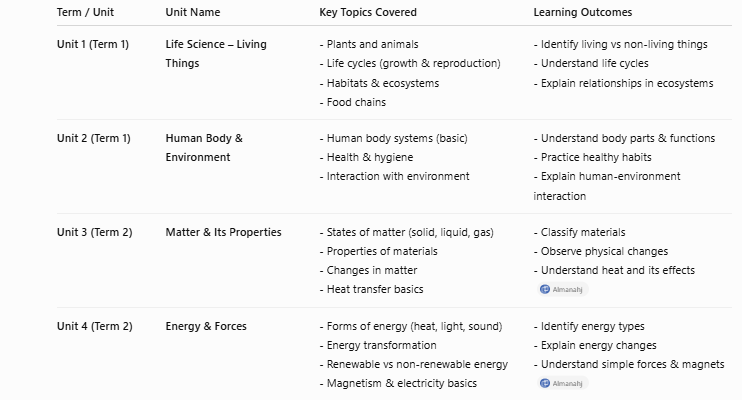
Unit-wise Syllabus Table
| Term / Unit | Unit Name | Key Topics Covered | Learning Outcomes |
|---|---|---|---|
| Unit 1 (Term 1) | Life Science – Living Things | – Plants and animals – Life cycles (growth & reproduction) – Habitats & ecosystems – Food chains |
– Identify living vs non-living things – Understand life cycles – Explain relationships in ecosystems |
| Unit 2 (Term 1) | Human Body & Environment | – Human body systems (basic) – Health & hygiene – Interaction with environment |
– Understand body parts & functions – Practice healthy habits – Explain human-environment interaction |
| Unit 3 (Term 2) | Matter & Its Properties | – States of matter (solid, liquid, gas) – Properties of materials – Changes in matter – Heat transfer basics |
– Classify materials – Observe physical changes – Understand heat and its effects |
| Unit 4 (Term 2) | Energy & Forces | – Forms of energy (heat, light, sound) – Energy transformation – Renewable vs non-renewable energy – Magnetism & electricity basics |
– Identify energy types – Explain energy changes – Understand simple forces & magnets |
Key Highlights of the Curriculum
- Concept-based learning: Focus on observation, experiments, and inquiry
- Local relevance: Includes examples from Kuwait (e.g., environment, energy/oil context)
- Skill development:
- Scientific thinking
- Problem-solving
- Real-life application
Kuwait Grade 3 Science Curriculum 2026–27: Chapter-wise / Lesson-wise Breakdown
Note: Kuwait MOE curriculum follows a theme-based approach (“Me and My Country”) with lessons grouped into units rather than rigid “chapters.”
Unit 1: Life Science – Living Things & Animals
| Chapter / Lesson No. | Lesson Name | Key Concept |
|---|---|---|
| Lesson 1 | How do fish live in water? | Adaptation of fish |
| Lesson 2 | How do fish breathe and move? | Gills & movement |
| Lesson 3 | Why do fish have different body shapes? | Body structure & function |
| Lesson 4 | Life cycles of animals | Growth & reproduction |
| Lesson 5 | Types of animals (vertebrates & invertebrates) | Classification |
| Lesson 6 | Animal habitats | Environment & survival |
These lessons are explicitly mentioned in Kuwait lesson distribution files (e.g., fish-related lessons in Unit 1).
Unit 2: Humans & Environment
| Chapter / Lesson No. | Lesson Name | Key Concept |
|---|---|---|
| Lesson 1 | Human body basics | Body parts & functions |
| Lesson 2 | Healthy habits | Hygiene & nutrition |
| Lesson 3 | Human interaction with environment | Environment care |
| Lesson 4 | Food chains | Energy flow |
| Lesson 5 | Ecosystems around us | Living together |
Unit 3: Matter & Materials
| Chapter / Lesson No. | Lesson Name | Key Concept |
|---|---|---|
| Lesson 1 | What is matter? | Definition & examples |
| Lesson 2 | States of matter | Solid, liquid, gas |
| Lesson 3 | Properties of materials | Hardness, texture, etc. |
| Lesson 4 | Changes in matter | Physical changes |
| Lesson 5 | Heat and temperature | Heat transfer basics |
Includes material properties and heat concepts as per Kuwait term-2 plan.
Unit 4: Energy, Forces & Magnetism
| Chapter / Lesson No. | Lesson Name | Key Concept |
|---|---|---|
| Lesson 1 | Forms of energy | Light, heat, sound |
| Lesson 2 | Sources of energy | Renewable & non-renewable |
| Lesson 3 | Forces and motion | Push & pull |
| Lesson 4 | Magnets | Magnetic force |
| Lesson 5 | Uses of magnets | Daily applications |
Magnetism, forces, and energy transformations are core topics in Grade 3 Kuwait science.
Unit 5: Earth & Kuwait Environment (Applied Science)
| Chapter / Lesson No. | Lesson Name | Key Concept |
|---|---|---|
| Lesson 1 | Soil in Kuwait | Types & uses |
| Lesson 2 | Water resources | Importance of water |
| Lesson 3 | Weather in Kuwait | Climate basics |
| Lesson 4 | Natural resources (oil focus) | National context |
| Lesson 5 | Protecting the environment | Conservation |
Kuwait curriculum emphasizes real-life applications (e.g., oil, environment) at this stage.
Summary
- Total Units: 4–5 major units
- Total Lessons: ~20–25 lessons
- Structure:
- Term 1 → Life Science + Human Body
- Term 2 → Matter, Energy, Forces + Environment
Grade 3 Science Curriculum Comparison (Kuwait vs CBSE vs UK vs USA)
Clear comparison of Kuwait vs CBSE (India) vs British (UK) vs American (US) Grade 3 Science Curriculum, designed to help you understand differences in content, approach, and difficulty level.
Comparison Table
| Aspect | Kuwait Curriculum | CBSE (India) | British (UK – KS2 Year 3) | American (US – NGSS based) |
|---|---|---|---|---|
| Curriculum Type | Thematic (Me & My Country) | EVS-based integrated | Subject-based (Biology, Physics, Chemistry basics) | Standards-based (NGSS) |
| Core Subjects | Life Science + Physical Science | Environmental Studies (EVS) | Plants, Animals, Rocks, Light, Forces | Life, Earth, Physical Science |
| Units / Themes | Living things, Matter, Energy, Environment | Family, Food, Water, Shelter, Travel | Plants, Animals, Rocks, Light, Forces & Magnets | Ecosystems, Earth, Energy, Forces |
| Approach | Activity + real-life (Kuwait context) | Observation + storytelling | Scientific enquiry + experiments | Inquiry-based & project learning |
| Depth Level | Moderate | Basic (concept introduction) | Moderate to advanced | Conceptual & application-based |
| Scientific Skills | Observation, classification | Awareness & basic observation | Experiments, data recording | Investigation, modeling, explanation |
| Local Context | Strong (oil, desert, environment) | Strong (family, Indian environment) | Limited (general science) | Minimal (global concepts) |
| Assessment Style | Activity + written | Mostly descriptive | Tests + practical work | Projects + assessments |
Topic-wise Comparison
1. Life Science (Plants & Animals)
| Kuwait | CBSE | UK | USA |
|---|---|---|---|
| Focus on fish, animals, habitats, ecosystems | Plants, animals, food, family | Plants parts, nutrition, animals | Life cycles, ecosystems, adaptations |
| Real-life Kuwait examples | Daily life examples | Scientific classification begins | Deep ecosystem understanding |
Insight:
- Kuwait & USA → More focus on ecosystems
- CBSE → More basic awareness
- UK → More structured scientific classification
2. Matter & Materials
| Kuwait | CBSE | UK | USA |
|---|---|---|---|
| States of matter, heat basics | Very limited (basic materials) | Rocks, soils, materials | Matter, properties, changes |
| Practical observation | Everyday materials | Scientific grouping | Experiments & modeling |
Insight:
- Kuwait & USA → Introduce scientific concepts early
- UK → Adds geology (rocks/soil)
- CBSE → Least depth at Grade 3
3. Energy, Forces & Physics
| Kuwait | CBSE | UK | USA |
|---|---|---|---|
| Energy types, magnets, forces | Minimal (basic EVS level) | Light, forces, magnets | Forces, motion, energy systems |
| Real-life application | Very basic | Experimental approach | Conceptual + engineering link |
Insight:
- USA → Most advanced & application-based
- UK → Strong experimental learning
- Kuwait → Balanced approach
- CBSE → Introduced later (Grade 5+)
4. Earth & Environment
| Kuwait | CBSE | UK | USA |
|---|---|---|---|
| Kuwait environment, oil, desert | Water, air, surroundings | Rocks, soils, fossils | Earth systems, weather, resources |
| Strong local focus | Social + environmental | Scientific geology | Global environmental systems |
Insight:
- Kuwait → Most localized learning
- USA → Most scientific + global view
- UK → Strong earth science basics
- CBSE → Focus on environmental awareness
Key Differences Explained
1. Difficulty Level
- Easiest: CBSE (basic EVS)
- Moderate: Kuwait
- Moderate–Advanced: UK
- Most Advanced: USA (NGSS)
2. Teaching Approach
- Kuwait: Real-life + national context
- CBSE: Story-based + awareness
- UK: Scientific enquiry & experiments
- USA: Inquiry + problem-solving (NGSS model)
3. Skill Development
- USA & UK: Strong focus on:
- Investigation
- Data analysis
- Scientific reasoning
- Kuwait: Balanced (concept + application)
- CBSE: Foundation building
Final Summary
- 🇰🇼 Kuwait: Balanced + real-life (best for contextual learning)
- 🇮🇳 CBSE: Simple + foundational (best for beginners)
- 🇬🇧 UK: Structured + experimental (strong scientific base)
- 🇺🇸 USA: Advanced + inquiry-based (best for critical thinking)
About The Author
