
Maharatna companies represent the highest tier of India’s Central Public Sector Enterprises (CPSEs). The Government of India introduced this elite status in 2010 to empower the largest and best-performing public sector companies with greater financial and operational autonomy. The goal was simple yet ambitious: enable these giants to expand aggressively in domestic and global markets, compete with multinational corporations, and drive national economic priorities without constant bureaucratic delays.
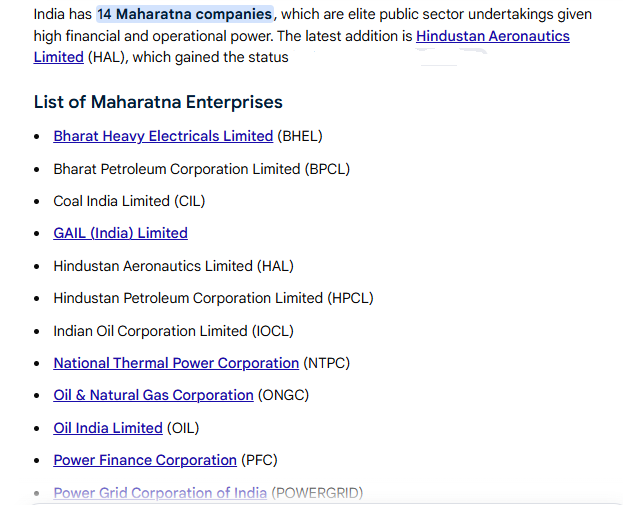
As of 2026, India has 14 Maharatna companies. The most recent addition is Hindustan Aeronautics Limited (HAL), which received the status in October 2024. These enterprises dominate critical sectors such as energy, oil & gas, power, steel, mining, heavy engineering, defence, aerospace, and infrastructure finance. Together, they form the backbone of India’s strategic and industrial strength.
What is a Maharatna Company?
A Maharatna is a top-performing CPSE that has already held Navratna status and meets stringent financial, listing, and international presence criteria. The Department of Public Enterprises (DPE) under the Ministry of Finance oversees the scheme. The status grants the company’s board significantly higher decision-making powers than Navratna or Miniratna CPSEs.
The scheme was formally launched on 19 May 2010. Its core objective is to transform large CPSEs into global giants by reducing the need for prior government approvals on major investments, joint ventures, mergers, and overseas expansion.
Eligibility Criteria for Maharatna Status
A CPSE must satisfy all of the following conditions:
| Criteria | Requirement |
|---|---|
| Prior Status | Must already hold Navratna status |
| Listing | Listed on an Indian stock exchange with minimum public shareholding as per SEBI norms |
| Average Annual Turnover (last 3 years) | More than ₹25,000 crore |
| Average Annual Net Worth (last 3 years) | More than ₹15,000 crore |
| Average Annual Net Profit after Tax (last 3 years) | More than ₹5,000 crore |
| Global Presence | Significant international operations or global footprint |
The proposal is initiated by the administrative ministry, reviewed by an Inter-Ministerial Committee, examined by an Apex Committee (headed by the Cabinet Secretary), and finally approved by the competent authority (usually the Finance Minister or Cabinet Committee).
Note (2026 update): In mid-2026, BHEL and SAIL were placed under a one-year performance review because they did not meet the average net profit threshold of ₹5,000 crore over the preceding three years, even though they satisfied the turnover and net-worth criteria. The government is also examining whether the 2010 financial thresholds should be indexed to current prices.
Complete List of Maharatna Companies in India (2026)
| No. | Company Name | Sector | Year of Maharatna Status |
|---|---|---|---|
| 1 | Oil and Natural Gas Corporation (ONGC) | Oil & Gas | 2010 |
| 2 | NTPC Limited | Power Generation | 2010 |
| 3 | Indian Oil Corporation Limited (IOCL) | Oil Refining & Marketing | 2010 |
| 4 | Steel Authority of India Limited (SAIL) | Steel | 2010 |
| 5 | Coal India Limited (CIL) | Coal Mining | 2011 |
| 6 | Bharat Heavy Electricals Limited (BHEL) | Heavy Engineering & Power Equipment | 2013 |
| 7 | GAIL (India) Limited | Natural Gas | 2013 |
| 8 | Bharat Petroleum Corporation Limited (BPCL) | Oil Refining & Marketing | 2017 |
| 9 | Hindustan Petroleum Corporation Limited (HPCL) | Oil Refining & Marketing | 2017 |
| 10 | Power Grid Corporation of India Limited (PGCIL / POWERGRID) | Power Transmission | 2019 |
| 11 | Power Finance Corporation Limited (PFC) | Power Sector Finance | 2021 |
| 12 | REC Limited (formerly Rural Electrification Corporation) | Infrastructure & Power Finance | 2022 |
| 13 | Oil India Limited (OIL) | Oil & Gas Exploration | 2023 |
| 14 | Hindustan Aeronautics Limited (HAL) | Defence & Aerospace | 2024 |
ONGC, NTPC, IOCL, and SAIL were among the first batch granted Maharatna status in 2010. HAL’s elevation marked a significant milestone for the defence manufacturing sector.
Key Benefits of Maharatna Status
Maharatna status confers the highest level of autonomy among CPSEs:
- Financial Autonomy: The board can invest up to ₹5,000 crore (or 15% of the company’s net worth, whichever is lower) in a single project or equity investment in a joint venture/subsidiary without prior government approval.
- Capital Expenditure: Freedom to incur capital expenditure on new items or replacements without any monetary ceiling (subject to internal guidelines).
- Mergers, Acquisitions & Joint Ventures: Authority to form joint ventures, wholly-owned subsidiaries, and undertake mergers/acquisitions in India and abroad within the prescribed limits.
- Human Resource Powers: The board can create posts below board level and decide on HR policies, recruitment, and training independently.
- Fundraising & Global Expansion: Greater ease in raising resources from domestic and international markets and expanding overseas operations.
- Strategic Flexibility: Ability to enter technology partnerships and strategic alliances more rapidly.
These powers allow Maharatna companies to respond quickly to market opportunities and compete more effectively with large private and global players.
Difference Between Maharatna, Navratna and Miniratna
| Feature | Maharatna | Navratna | Miniratna (Cat I / II) |
|---|---|---|---|
| Investment Limit (per project) | Up to ₹5,000 crore or 15% of net worth | Up to ₹1,000 crore or 15% of net worth | Lower limits (₹500 crore / ₹300 crore range typically) |
| Prerequisite | Navratna status + high financial thresholds | Miniratna Cat-I + excellent MoU ratings | Continuous profits + positive net worth |
| Autonomy Level | Highest | High | Moderate |
| Global Expansion Freedom | Extensive | Limited | Restricted |
| Approximate Number (2026) | 14 | ~25–26 | ~65–74 |
Maharatna is the apex category; autonomy decreases as one moves down the ladder.
Impact of Maharatna Companies on the Indian Economy
Maharatna CPSEs punch far above their number in economic contribution:
- Energy Security: ONGC, OIL, IOCL, BPCL, HPCL, and GAIL collectively secure a large share of India’s domestic oil and gas production and refining capacity, reducing import dependence and stabilising fuel supplies.
- Power & Infrastructure: NTPC and POWERGRID drive large-scale power generation and transmission. PFC and REC finance critical power and infrastructure projects across the country.
- Strategic Sectors: HAL strengthens defence self-reliance (Atmanirbhar Bharat) by manufacturing aircraft, helicopters, and engines for the armed forces. BHEL supplies power plant equipment and supports heavy industry. CIL remains the world’s largest coal producer and a pillar of energy security.
- Employment & Regional Development: These 14 companies directly employ hundreds of thousands of people and generate substantial indirect employment through vendors and contractors. Many operate in remote or industrially backward regions.
- Government Revenue: They contribute significantly through dividends, corporate taxes, GST, and other levies, helping fund social and infrastructure programmes.
- Global Footprint: Several Maharatnas (especially ONGC Videsh, NTPC, GAIL, and IOCL) have overseas assets and projects, enhancing India’s energy diplomacy and international economic presence.
- National Priorities: They play central roles in schemes related to energy transition, rural electrification, defence modernisation, and industrial growth under Vision 2047.
Challenges and Recent Developments
Despite their strengths, some Maharatnas face cyclical pressures (commodity prices, global energy transitions, and competition). The 2026 review of BHEL and SAIL highlights that status is performance-linked and not permanent. Discussions are underway to update the 2010 financial thresholds so they remain relevant in a higher-inflation, higher-scale economy.
Conclusion
Maharatna companies are more than large public sector units; they are national champions entrusted with strategic autonomy to deliver energy security, industrial capacity, defence capability, and infrastructure growth. With 14 companies holding the status in 2026 and clearer performance accountability mechanisms emerging, the Maharatna framework continues to evolve as a powerful tool for making Indian CPSEs globally competitive while serving core national interests.
For UPSC aspirants and policy watchers, Maharatna status remains a high-value topic under Indian Economy (GS Paper III), covering public sector reforms, strategic industries, and the balance between autonomy and accountability.
About The Author
